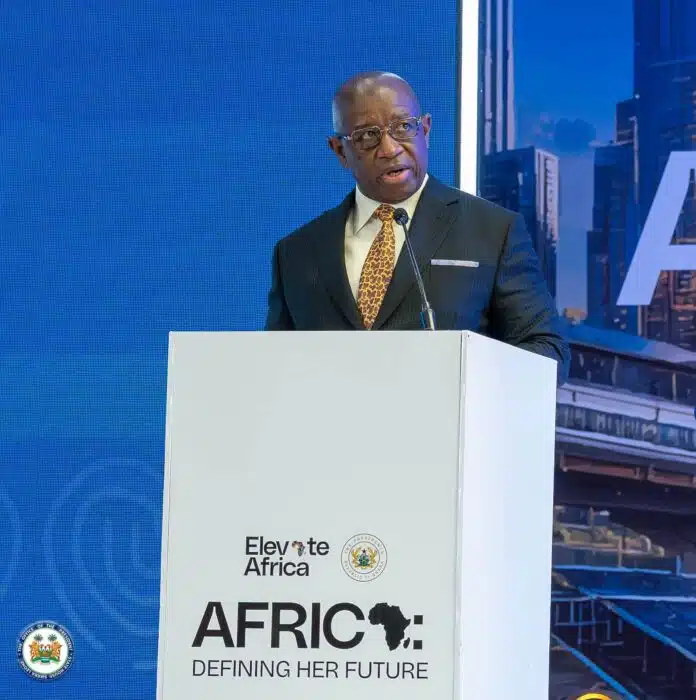
President Dr Julius Maada Bio delivered the keynote address at the Elevate Africa Convening 2026 in Accra, Ghana, on October 28, 2026. He stated, "Political independence gave us the authority to make our own decisions. True sovereignty requires the capacity to carry those decisions through." Regarding economic goals, President Dr Julius Maada Bio noted, "Our resources must create industries, jobs and wealth for our people. That is how economic sovereignty becomes a reality." He added, "I want to see a business in Freetown able to trade with customers in Accra without unnecessary obstacles." President Dr Julius Maada Bio further remarked, "Before we leave Accra, let each of us identify one commitment we are prepared to finance, implement and account for."
Prioritizing Economic Independence and Trade
President Dr Julius Maada Bio advocated for the implementation of the African Continental Free Trade Area to improve regional trade. He stated that the removal of barriers between African nations is a requirement for internal growth. By streamlining trade protocols, he suggested that the continent can reduce its reliance on external markets. The operationalization of the African Continental Free Trade Area remains a critical priority for his administration as it seeks to integrate regional markets more effectively. He urged participants at the convening to consider the long-term benefits of a unified trade space, noting that the removal of tariff and non-tariff barriers would facilitate the movement of goods and services across borders.
African economies must move away from exporting unprocessed minerals and agricultural commodities, according to President Dr Julius Maada Bio. He argued that current trade patterns benefit foreign processors rather than the nations where resources originate. The shift toward domestic value addition remains a central component of his vision for long-term economic stability. By processing raw materials within the continent, he stated that countries can retain more profit and generate more industrial employment. President Dr Julius Maada Bio emphasized that this transition is essential to transforming the economic landscape of the continent. He pointed out that relying on the export of raw materials leaves nations vulnerable to global price fluctuations, whereas investing in domestic processing facilities allows for the creation of sustainable value chains.
Sierra Leone implemented the Free Quality School Education Programme in 2018 to support these economic objectives. President Dr Julius Maada Bio noted this programme, which was introduced in 2018, as a foundational element of his national development strategy. He linked the success of national development to the quality of human capital produced by the education system. The programme provides tuition-free schooling to students across the country. He noted that the initiative remains a primary vehicle for preparing the youth to participate in a modern, industrial economy. By ensuring that the next generation is equipped with necessary skills, the government aims to foster an environment where industrialization and economic sovereignty can flourish. President Dr Julius Maada Bio stated that education serves as the bedrock for all other development efforts, ensuring that the workforce is ready to meet the demands of an evolving continental market.