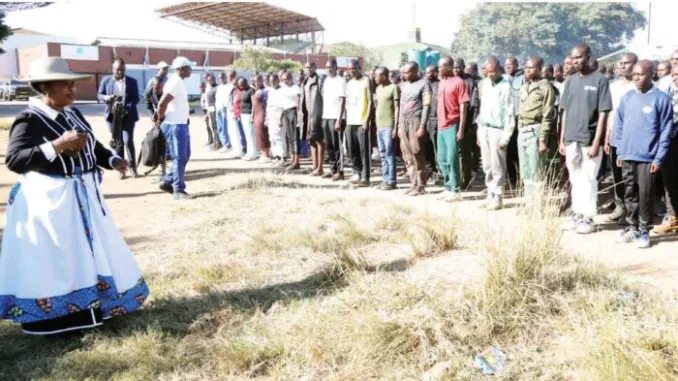
Beneficiaries from the Angel of Hope Drug Rehabilitation Centre in Harare, Zimbabwe, received a hero's welcome upon their return from vocational training, symbolizing a significant personal transformation and a new chapter in their lives. The event marked a poignant moment for the graduates, who have undergone an intensive rehabilitation program followed by skills development. First Lady Dr Auxillia Mnangagwa, the centre's patron and a driving force behind its establishment, led the heartwarming welcome ceremony, acknowledging their remarkable progress and offering invaluable guidance for their future endeavors. The atmosphere was charged with emotion and hope as the graduates were described as transformed individuals – brighter, upright, and commendably drug-free, marking a profoundly positive outcome for the full program. Their return was not merely a physical journey but a testament to their resilience and the effectiveness of the support system provided by the centre.
Dr Mnangagwa, visibly moved by the achievements of the young men and women, expressed her profound satisfaction with their progress. "I am pleased to see the positive transformation in my children," she stated, her words resonating with maternal care and encouragement. Her address, however, carried a key message of caution and empowerment for the path ahead. "However, I urge you not to return to the same streets, to drug dealers, or to places of temptation. Protect yourselves, remain focused, and live wisely," she advised, emphasizing the importance of sustained vigilance and commitment to their new lives. These graduates represent six distinct groups that have successfully completed their vocational skills training through the initiative, showcasing the program's consistent impact across multiple cohorts. Their collective success notes the centre's dedication to not only addressing substance abuse but also equipping individuals with practical skills for self-sufficiency.
Stories of Transformation and New Beginnings
The stories shared by the graduates painted vivid pictures of personal battles fought and victories won, showing the profound impact of the rehabilitation and vocational training. Kudzanai Nyakasaka, a name once synonymous with promising talent in the football arena, was among the graduates. His career as a former Premier League player had been tragically derailed by the insidious grip of substance abuse. Now, with renewed vigor and clarity, Mr. Nyakasaka expressed his fervent desire to return to professional football. "I want to go back to football. I know I can still do it. I want to restore my career. I want to make my mother smile again, not cry," Mr. Nyakasaka stated, his voice filled with determination. He recounted his past struggles with candid honesty, saying, "I used to play for Dynamos, but drugs affected me. I now feel energetic and I can train with others again. I can play any position. My message to fellow footballers is that drugs kill talent." His aspiration to rejoin the professional ranks serves as a powerful testament to his recovery and the potential for former athletes to reclaim their careers after overcoming addiction.
Salmor White, another inspiring graduate, shared ambitious plans to venture into aquaculture, a field that promises both personal sustenance and economic contribution. "From the skills I learned, I am now going to venture into aquaculture so I can farm fish and make a living, support my family, and also contribute to our economy," Mr. White said, outlining a clear path forward. He noted a significant personal change that extended beyond vocational skills, adding, "I have transformed a lot. I can now communicate well with my parents, something I never did before." This improvement in familial relationships speaks volumes about the holistic recovery fostered by the centre. Valeria Matongo, reflecting on her journey, spoke of learning diverse skills in farming and hair braiding during her time at the centre. "If it was not for the Angel of Hope, I would be in jail. When I first came, I even insulted them from my heart, but as time went on during the programme, I regained myself," Ms. Matongo commented, noting her initial resistance and eventual embrace of the program. She elaborated on her newly acquired capabilities, stating, "After vocational training, I learned several skills and I can now farm. I used to braid hair, and I will now continue with that passion, which I had failed to do because of drugs." Her story is one of reclaiming lost passions and finding new avenues for economic independence.
Takudzwa Kazingizi, a graduate who proudly holds a certificate in engineering, expressed his clear ambition to establish his own welding business. His vision is not just for personal gain but also for supporting his family. "I now want to buy welding equipment and start manufacturing furniture so I can take care of myself while also supporting my mother for raising me," Mr. Kazingizi said, demonstrating a strong sense of responsibility and gratitude. He reflected with solemnity on the detrimental impact of substance abuse on his life, noting, "Drugs set me back a lot. I am going to change friends because others my age are now married and doing different jobs, while I was left behind because of drugs. I had also lost my appetite, but now I have regained it." His commitment to changing his social circle shows a critical aspect of sustained recovery.
Keith Mutandagari, a former national under-17 and under-21 soccer player, was also among the distinguished graduates. His past included playing for prominent local clubs before addiction took hold. Mr. Mutandagari detailed his past struggles with candor, saying, "Locally, I used to play for Harare City and Cranborne Bullets. I was taking mutoriro, marijuana, and bronco, and I stopped going for training. I was a good player. I played for the Zimbabwe Under-17 and Under-20 teams and travelled widely." His narrative is a stark reminder of how addiction can derail even the most promising careers. He expressed his profound hope for the future, adding, "I want to resuscitate my career. Drugs are dangerous; they had ruined me." Abigail Tsauro, another successful graduate, is now proficient and able to engage in farming and horticulture, skills that promise a sustainable livelihood. Ms. Tsauro conveyed her deep gratitude for the intervention, stating, "I am grateful because the drugs have been removed from my body. If this programme had not come, I would already be dead and buried." This powerful statement notes the life-saving impact of the rehabilitation centre. She also offered a poignant message to other young people struggling with addiction, saying, "Now that I am leaving, I am able to do farming and horticulture to sustain my life. To other youths, I say let us stop drug abuse. Drugs have no future. Let us help each other fight drugs so we can build our country together." Her words serve as both a warning and an appeal for collective action against drug abuse.
A Model for Recovery and Reintegration
The Angel of Hope Drug Rehabilitation Centre stands as a beacon of hope, not only through its immediate rehabilitation services but also by fostering pathways for long-term success and reintegration. Some graduates from the centre have, in a remarkable demonstration of ambition and continued growth, continued their educational journeys abroad. These individuals have proceeded to Algeria for further studies, building significantly on the foundational vocational training they received in Zimbabwe. This advancement represents a new and exciting opportunity for these graduates to acquire additional specialized skills and knowledge, thereby supporting their full and meaningful reintegration into society and the broader economy. The initiative aims to provide full support that extends beyond the initial rehabilitation phase, focusing not only on vocational training but also by actively facilitating pathways for continued personal and professional development. This includes securing opportunities for advanced learning and skill acquisition, both domestically and internationally.
The program's holistic approach emphasizes equipping participants with the necessary resources and tools needed to establish sustainable livelihoods and contribute positively to their families and communities. The success of those pursuing further studies in Algeria shows the centre's commitment to creating global citizens who are not only rehabilitated but also empowered to compete on an international stage. This ongoing support mechanism, which includes follow-up and assistance in finding employment or educational opportunities, notes the unwavering dedication to ensuring long-term success and preventing relapse for the individuals who complete the rigorous rehabilitation program. The centre's model is increasingly being recognized as an effective strategy for tackling the complex challenges of drug abuse and fostering genuine societal reintegration. It serves as an example of how targeted interventions, combined with opportunities for skill development and further education, can transform lives and build a stronger, more productive future for a nation's youth.
Voices of Hope and Gratitude
The article is published courtesy of Herald Online.