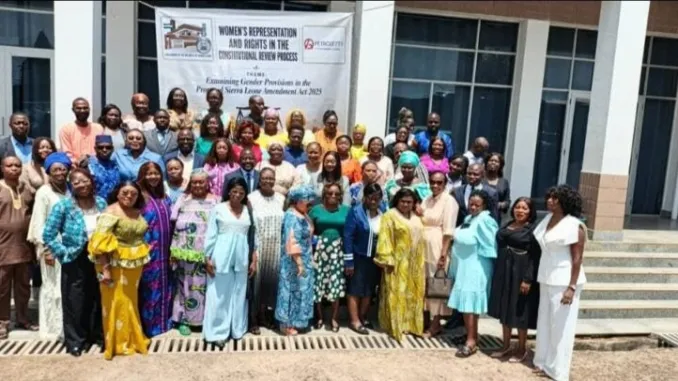
A two-day engagement was held on Thursday, 7th May 2026, at Committee Room One, Parliament Building in Freetown, Sierra Leone, bringing together female legislators, government representatives, civil society actors, and development stakeholders. The event aimed to strengthen women’s participation in constitutional reforms and deepen discussions on equality, inclusion, representation, and the protection of women’s rights. This significant gathering shows a concerted effort to embed gender considerations deeply within the nation's foundational legal framework.
The engagement, co-funded by the Parliament of Sierra Leone and PetroJetty, focused on the theme “Examining Gender Provisions in the Proposed Constitution of Sierra Leone Amendment Act 2025.” Participants convened to analyze the proposed amendments and ensure gender considerations are adequately addressed within the constitutional review process. The collaborative effort between legislative bodies and private sector partners like PetroJetty notes a broad commitment to advancing gender equality in the country. The discussions were structured to foster full understanding and critical evaluation of the proposed changes, ensuring that the voices and priorities of women are central to the reform agenda.
Reviewing Proposed Constitutional Amendments
The proposed Constitution Amendment Act 2025 is presented as a transformative pathway towards a more inclusive democracy, social justice, and economic prosperity for Sierra Leone. This ambitious legislative proposal seeks to address long-standing issues and lay the groundwork for a more equitable society. Key among its provisions, the proposed constitutional amendments aim to institutionalize a 30 percent quota for women, thereby strengthening their participation in governance and public leadership. These provisions are designed to guarantee gender equality, improve access to education and healthcare services, and provide stronger protections for women and girls. Additionally, the amendments seek to strengthen citizenship and nationality rights, ensuring that all citizens, particularly women, have their rights fully recognized and protected under the law. The Act is envisioned as a key step in cementing the rights and roles of women across all sectors of Sierra Leonean society.
Discussions during the engagement focused on several critical areas, including the promotion of equality, inclusion, and non-discrimination. Participants also examined ways to protect citizenship and nationality rights, strengthen women’s representation and participation in governance, and safeguard women’s rights, human dignity, and social justice. These full deliberations sought to cover all facets of women’s lives and their interaction with the constitutional framework. The deliberations specifically centered on the recommendations put forth by the Constitutional Review Committee and commitments outlined in the White Paper, which have served as foundational documents for the reform process. Attention was also given to existing constitutional gaps requiring new legal safeguards, as well as the strategic priorities women aim to see reflected in the proposed Constitution of Sierra Leone. By meticulously reviewing these elements, participants aimed to ensure that the final amendment act is strong and truly reflective of the needs and aspirations of Sierra Leonean women. The engagement served as a vital platform for stakeholders to dissect each proposed clause and its potential impact on gender parity.
Progress and Legislative Milestones
Early institutional efforts under the ACBF Project were initiated to amplify women’s voices within Parliament and increase their political participation. These initiatives have contributed to notable advancements in gender representation, laying the groundwork for more substantial legislative changes. Significant progress has been recorded, including the attainment of the 30 percent representation benchmark for women, a testament to the effectiveness of targeted interventions and advocacy. This benchmark reflects a concerted effort to enhance women's roles in governance and ensure their active involvement in decision-making processes at the highest levels. The ongoing constitutional review seeks to solidify these gains and ensure their permanence within the legal framework.
The engagement specifically examines the progress achieved through the Gender Equality and Women’s Empowerment (GEWE) Act 2022. This legislation has been instrumental, particularly in the attainment of the 30 percent quota representation during the 2023 general elections, demonstrating its immediate and tangible impact on political participation. Beyond the GEWE Act, Sierra Leone has enacted other landmark legislations in recent years that show its commitment to protecting women and girls. These include the Sexual Offences Act, which addresses sexual violence with stricter penalties and improved victim support mechanisms, and the Prohibition of Child Marriage Act, aimed at protecting minors from harmful traditional practices and ensuring their right to education and a safe childhood. These legislative milestones collectively represent a significant stride towards a more just and equitable society, complementing the ongoing efforts to enshrine gender equality within the constitution itself.
Broader Reform Context
Electoral reform is intrinsically linked to gender reform efforts in Sierra Leone, according to discussions during the two-day engagement. The government intends to introduce additional legal reforms as part of a broader legislative agenda, signaling a full approach to modernizing the nation's legal landscape. These future reforms are expected to include legislation pertaining to mediation and community service, which could further enhance access to justice and promote peaceful conflict resolution, particularly benefiting women in local communities. Participants at the event are reviewing women’s priorities, which are contained in the Bank Complex Communiqué and the Women’s Manifesto. These documents outline key demands and aspirations for gender equality and women's rights within the ongoing constitutional review process, serving as critical guides for the discussions. The integration of these priorities into the proposed amendments is key for ensuring that the constitutional changes genuinely reflect the lived experiences and needs of women across Sierra Leone. The emphasis on these foundational documents notes the participatory nature of the reform process, ensuring that the voices of women's rights advocates and organizations are heard and incorporated into the final legal framework.