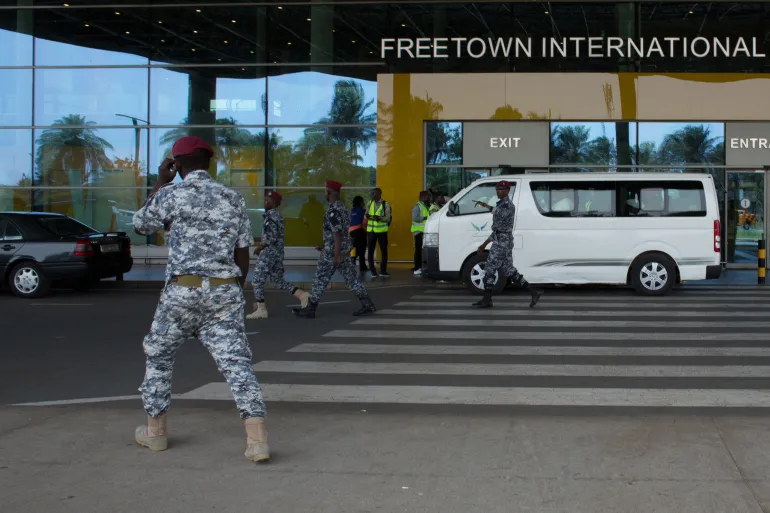
Sierra Leone received its first group of deportees from the United States when a plane carrying nine migrants arrived in the country. This marks a significant development in international migration policy, as it represents the initial arrival of such deportees from the United States to the West African nation. The individuals, who originated from various West African countries, were flown to Sierra Leone as part of a deportation process that has drawn both international attention and scrutiny. The arrival of the first plane, carrying nine migrants from several West African nations, shows the operationalization of a new agreement between the two countries. This arrangement establishes Sierra Leone as a temporary receiving country for individuals being deported from the United States, particularly those whose countries of origin are elsewhere in the West African region. The event signals a new phase in the United States' approach to immigration enforcement and its collaboration with African nations on deportation matters.
Deportees' Ordeal and Immediate Future
The arrivals on Wednesday, May 20, 2026, at the airport near Freetown included five people from Ghana, two from Guinea, one from Senegal, and one from Nigeria. Upon their arrival, the deportees shared accounts of their experiences leading up to their removal from the United States. Some of the deportees reported being arrested abruptly on the streets, while others were apprehended at their places of work in the United States. One individual recounted a particularly jarring experience, stating they were arrested while engaged in a casual game of football. These accounts highlight the varied circumstances under which the individuals were taken into custody by US authorities.
Following their arrival in Sierra Leone, most of the deportees expressed a strong desire to return to their home countries as soon as possible. The immediate plan for the group is to be housed temporarily in a hotel, where they will receive necessary support. Expectations are that they will be able to proceed with their journeys to their respective countries of origin within the next two weeks. This temporary lodging and onward travel arrangement is a key component of the agreement between Sierra Leone and the United States, designed to facilitate the reintegration or onward movement of the deportees. The emotional and physical toll of their journey was evident, with the deportees described as traumatised, a condition attributed to reportedly spending months in chains during their detention in the United States.
US Deportation Deals Abroad
The Sierra Leonean government has agreed to a term that allows it to receive migrants for approximately 90 days before they proceed with their journeys to their home countries. This period is intended to facilitate the necessary arrangements for their onward travel and to provide a temporary humanitarian buffer. The agreement with Sierra Leone is supported by a substantial $1.5 million grant provided by the US government. This funding is specifically designated to cover both humanitarian and operational costs associated with implementing the agreement, ensuring that Sierra Leone has the resources to manage the influx and subsequent movement of the deportees.
This arrangement with Sierra Leone is not an isolated incident but rather part of a broader strategy employed by the United States. The United States has established similar third-country deportation agreements with at least eight other African nations. These agreements are designed to create pathways for the deportation of non-citizens who do not originate from the receiving country but are processed through it. The countries known to have signed such deals with the United States include the Democratic Republic of Congo, Equatorial Guinea, South Sudan, Rwanda, Uganda, Eswatini, Ghana, and Cameroon. These partnerships reflect a concerted effort by the US to expand its options for immigrant removal, often leveraging diplomatic and financial incentives. The establishment of these "third-country" agreements has become a notable feature of US immigration enforcement policy in recent years.
Human Rights Concerns
The arrival of the deportees in Sierra Leone, described as traumatised, immediately raised concerns among human rights advocates. The accounts of reportedly spending months in chains during their detention in the United States show the harsh conditions some individuals face within the US immigration system. These reports contribute to a wider debate about the treatment of detainees and the methods employed during deportation processes.
Human Rights Watch, a prominent international advocacy organization, has been vocal in its criticism of these types of arrangements. The organization raised significant concerns in September, arguing about the broader implications of such agreements. Human Rights Watch specifically contended that these "opaque deals" were "part of a US policy approach that violated international human rights law." The organization's critique centers on the lack of transparency surrounding these agreements, as well as the potential for them to undermine international protections for migrants and asylum seekers. Critics argue that by outsourcing the processing and onward movement of deportees to third countries, the United States may be sidestepping its responsibilities under international law and potentially exposing vulnerable individuals to further risks. The call for greater transparency and adherence to human rights standards in these deportation agreements continues to be a key point of discussion for international observers and advocacy groups.