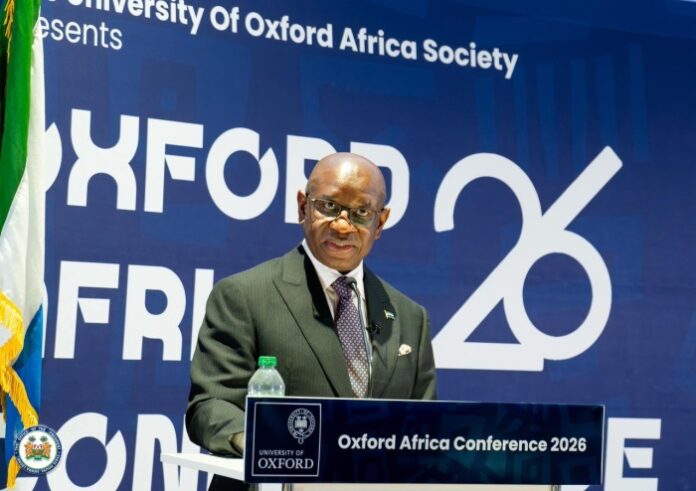
President Julius Maada Bio delivered the Presidential Keynote Address at the 2026 Oxford Africa Conference on Sunday, May 17, 2026. The event, held in the historic city of Oxford, England, saw President Bio address a distinguished gathering on the critical importance of strong institutions and tangible, impactful democracy for the continent's sustained development. His participation in this prominent forum showed the Republic of Sierra Leone's unwavering commitment to actively engaging in international dialogues focused on Africa's future trajectory and its governance challenges. The conference itself, a significant annual gathering for discussions on African affairs, provided an invaluable platform for leaders, academics, and policymakers to articulate their visions for progress and address the continent's most pressing issues. President Bio's full address noted the ongoing efforts within the Republic of Sierra Leone to strengthen democratic principles and reinforce institutional frameworks, setting a precedent for other nations to follow.
Africa's Stability Imperative
In his compelling address, President Julius Maada Bio asserted that Africa's future profoundly relies on its intrinsic ability to reclaim its voice on the global stage and to establish durable systems that are capable of withstanding various global challenges. He reflected on previous discussions, stating, "Last year, standing on this same platform, I spoke about African agency. This year, we must ask something harder: Can what we define endure? Can it survive shocks and disruption?" This rhetorical question showed the urgency of building resilient systems. President Bio cautioned that crises such as drought, while seemingly localized, have the potential to escalate rapidly into broader food, revenue, and security crises, illustrating a dangerous domino effect. "A drought does not stay a drought. It becomes a food crisis. A food crisis becomes a revenue crisis. A revenue crisis becomes a security crisis," he explained, emphasizing the interconnectedness of environmental, economic, and security challenges.
President Bio observed with concern that the increasing number of coups and unconstitutional changes of government across the continent often signal deeper governance failures and a significant decline in public trust. He emphasized that for democracy to be truly meaningful and effective, it must extend far beyond the mere act of holding elections; it must actively deliver tangible benefits and improvements in the daily lives of its citizens. "Democracy goes far beyond elections. To be meaningful, democracy must work in substance. Our responsibility is not only to defend democracy but to make it mean something in the daily lives of our citizens," President Bio added, articulating a vision where democratic governance directly translates into improved welfare. He further stressed that instability in one country inevitably spills over into neighboring states, creating regional insecurity and noting regional cooperation as an absolutely key element for collective survival and progress. "Regional cooperation is not an optional ideal but a survival strategy," President Bio said, advocating for stronger cross-border collaboration. He also pointed out that Africa is the world's youngest continent, a demographic reality that demands political systems to adapt proactively. He warned that if politics fails to adapt to this dynamic demographic reality, the frustration of the youth will outpace any reform efforts, potentially leading to widespread discontent and instability.
Delivering Tangible Results
President Bio reiterated his core message that democracy must work in substance and consistently deliver measurable results in the daily lives of citizens. To illustrate this commitment in practice, he noted Sierra Leone's flagship initiatives: the Free Quality Education Programme and the Feed Salone agricultural agenda, both serving as practical interventions designed to directly improve the welfare and opportunities of the populace. These programmes, he noted, exemplify how governance can directly address societal needs. Speaking on the rapid advancements in technological domains, President Bio proposed the ambitious establishment of a Pan-African AI governance framework. He articulated the necessity for such a framework, stating, "Artificial Intelligence is already reshaping economies, governance and society. Africa cannot afford to be a passive consumer of these systems," thereby advocating for Africa to be an active participant and shaper of global AI policies.
The President also issued a powerful challenge to young Africans and the diaspora, urging them to remain actively connected to the continent and to contribute their skills, knowledge, and resources to its development. "To the young Africans here, build where you stand. But stay connected to where you come from. The diaspora is not outside Africa’s story. The diaspora is one of Africa’s most powerful assets," President Bio remarked, acknowledging the immense potential and influence of the African diaspora. He also noted the profound injustice of climate change, stating that "The crisis [climate change] is one of the greatest injustices of our time," given Africa's minimal contribution to global emissions yet disproportionate suffering from its effects. This call to action showed the collective responsibility in addressing both continental and global challenges.
President Bio concluded his insightful address by asserting a powerful vision: "Africa can anchor its own story. We are already doing so. What remains is leadership steady enough to hold the ground where stability is needed and bold enough to change it where reform is overdue." This statement encapsulated his belief in Africa's self-determination and inherent capacity for progress.
Context and Future Vision
The 2026 Oxford Africa Conference centered its discussions around the compelling and timely theme, "Anchoring Africa: Grounded, Major Leadership in the Age of Disruption." President Dr. Julius Maada Bio's address resonated deeply with this theme, as he meticulously outlined how Africa, despite contributing the least to global carbon emissions, experiences a disproportionate burden of climate-related consequences, a stark example of global injustice. He further noted the continent's unique demographic reality, stating, "Africa is the world's youngest continent. If politics does not adapt to demographic reality, frustration will outrun reform," emphasizing the critical need for governance to evolve with its population. President Bio concluded his address by asserting that Africa possesses the inherent capacity to anchor its own narrative and shape its destiny, emphasizing that achieving this requires a combination of courageous reforms, strong institutional strength, and visionary leadership that is both grounded and major. This full vision calls for a proactive approach to governance and development, ensuring that Africa not only survives but thrives in an increasingly complex global landscape.