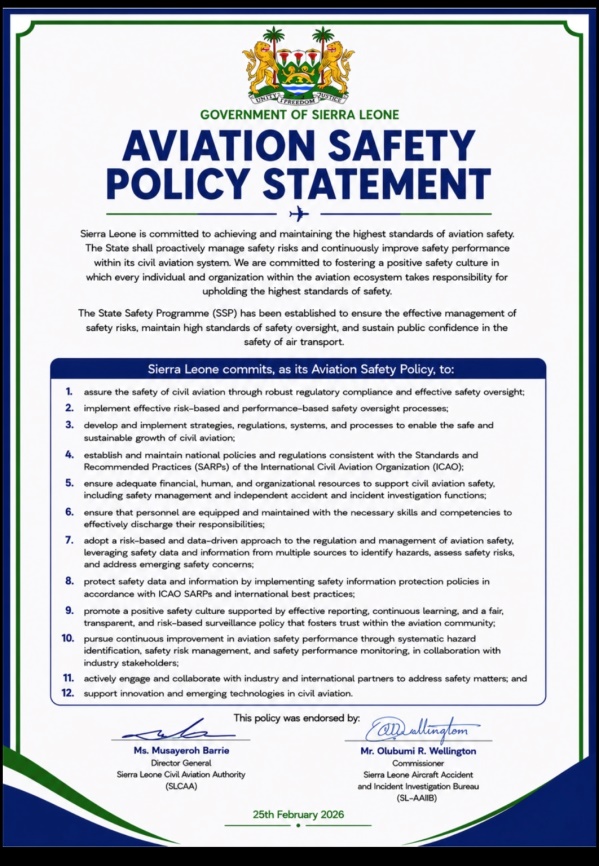
The Government of Sierra Leone has officially unveiled a full Aviation Safety Policy Statement, aiming to enhance the nation's air travel standards. The Minister of Transport and Aviation, Hon. Alhaji Fanday Turay Esq. Approved the policy on February 25th, 2026. This initiative marks a significant step for Sierra Leone in aligning its aviation safety framework with international best practices and ensuring a secure operational environment for air transport. The introduction of this policy is expected to boost confidence in Sierra Leone’s aviation industry and strengthen safety standards in line with international requirements, signaling a commitment to global aviation excellence.
Policy Objectives and Framework
The new policy shows Sierra Leone’s commitment to achieving and maintaining the highest standards of aviation safety through proactive risk management and continuous performance improvement. It establishes the State Safety Programme (SSP) to ensure effective management of aviation safety risks, maintain strong oversight mechanisms, and strengthen public trust in air transportation. The framework aims to modernize and improve aviation governance within the country. This modernization effort is key for adapting to the evolving landscape of global aviation and ensuring that Sierra Leone's regulatory environment remains strong and responsive.
The policy aligns Sierra Leone’s aviation system with the Standards and Recommended Practices (SARPs) of the International Civil Aviation Organization (ICAO), ensuring compliance with global aviation benchmarks. This alignment is designed to enhance operational safety and regulatory effectiveness across the nation's aviation sector, fostering a safer and more reliable air travel experience for all. By adhering to ICAO SARPs, Sierra Leone reinforces its dedication to a globally harmonized aviation system, which is vital for international connectivity and safety.
Commitments and Endorsements
The government of Sierra Leone pledged to ensure adequate financial, human, and organizational resources to support aviation safety initiatives. This commitment notes the government's understanding that effective safety management requires substantial and sustained investment. The new policy also encourages innovation and the adoption of emerging technologies within civil aviation, recognizing their potential to further enhance safety and efficiency in air operations. This forward-looking approach aims to position Sierra Leone's aviation sector at the forefront of technological advancements.
Ms. Musayeroh Barrie, Director General of the Sierra Leone Civil Aviation Authority (SLCAA), endorsed the Aviation Safety Policy. This endorsement signals the SLCAA's commitment to implementing the policy's framework and objectives, emphasizing the key role of the regulatory body in ensuring its success. The SLCAA's active involvement is instrumental in translating policy into practical, enforceable safety measures across the aviation industry.
Olubumi R. Wellington, Commissioner of the Sierra Leone Aircraft Accident and Incident Investigation Bureau (SL-AAIIB), also endorsed the Aviation Safety Policy. The SL-AAIIB's endorsement notes the collaborative effort among key aviation bodies in Sierra Leone to strengthen the nation's air safety standards and investigative capabilities. This cross-agency support is vital for a full approach to aviation safety, ensuring that both preventative measures and post-incident analysis are effectively managed.
Strengthening Aviation Governance
The newly introduced policy aims to strengthen safety oversight mechanisms, enhance regulatory compliance, and sustain public confidence across Sierra Leone's air transport system. Its implementation is anticipated to boost trust in the nation's aviation industry, aligning safety standards with international requirements. Key commitments outlined in the policy include the establishment of strong regulatory compliance frameworks, which are essential for ensuring that all aviation stakeholders adhere to established safety protocols.
The policy outlines the implementation of risk-based and performance-based safety oversight systems, which are designed to proactively manage potential hazards. These sophisticated oversight approaches allow for a more dynamic and effective identification and mitigation of risks, moving beyond traditional prescriptive regulations. These measures are intended to contribute to the development of strategies for sustainable growth within the civil aviation sector, ensuring that safety enhancements support, rather than hinder, industry expansion. The overarching goal is to ensure that Sierra Leone's aviation governance meets global benchmarks, fostering a secure and reliable air travel environment for passengers and operators alike.