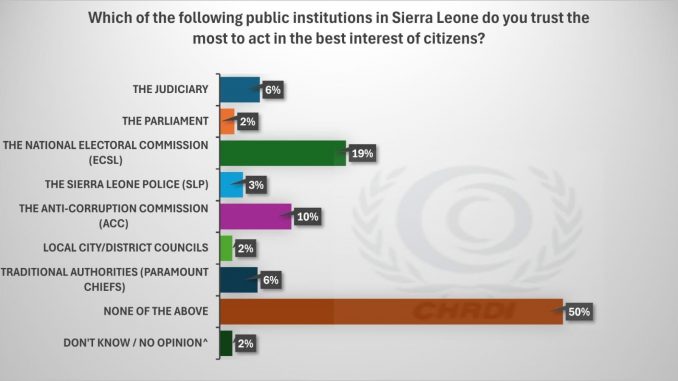
Public confidence in Sierra Leone’s governance system has reached a critical low, according to new findings released by the Campaign for Human Rights and Development International (CHRDI). An online opinion poll conducted by CHRDI asked citizens a specific question: “Which of the following public institutions in Sierra Leone do you trust the most to act in the best interest of citizens?” The results were stark, with half of the respondents indicating they do not trust any of the listed institutions. CHRDI stated, "This is a wake-up call. Without urgent action, the foundations of democracy and stability will remain vulnerable." The organization noted that such a widespread lack of trust poses a significant challenge to the nation's progress and democratic health.
CHRDI's Findings and Implications
The Campaign for Human Rights and Development International (CHRDI) emphasized that Sierra Leone cannot move forward without rebuilding public trust. The organization is calling for immediate and transparent reforms designed to restore accountability and strengthen public confidence in state institutions. CHRDI stated earlier, "This is a wake-up call. Without urgent action, the foundations of democracy and stability will remain vulnerable." The group showed the necessity of these measures to address the critical low in public confidence identified by their recent poll. The findings from this full online opinion poll provide concrete evidence of the deep-seated skepticism among the populace regarding the institutions meant to serve them. This data serves as a compelling argument for immediate and concerted efforts to bridge the widening gap between the government and its citizens.
Broader Context of Democratic Resilience
The Campaign for Human Rights and Development International (CHRDI) findings contribute to increasing concerns regarding Sierra Leone’s democratic resilience. These worries follow the 2023 general elections, which revealed institutional weaknesses within the country. The electoral process also exacerbated existing political divisions among the populace. The findings add to growing concerns about Sierra Leone’s democratic resilience following the 2023 general elections, which exposed institutional weaknesses and deepened political divisions. These events, coupled with the latest poll results, paint a picture of a nation grappling with fundamental challenges to its democratic framework. The erosion of trust, particularly in the aftermath of a significant national election, suggests that the underlying issues are systemic and require full solutions.
Calls for Reform and Action
When public trust erodes, the legitimacy of governance, the rule of law, and public safety are all placed at risk, according to assessments by civil society organizations. These groups are now urging government leaders in Sierra Leone to prioritize reforms designed to enhance transparency, accountability, and citizen engagement. Such measures are considered key for rebuilding confidence in state institutions and ensuring the long-term stability of the nation. Civil society groups are urging government leaders to prioritize reforms that enhance transparency, accountability, and citizen engagement. The calls for action reflect a broader concern that the current low levels of trust could undermine essential government functions and public welfare. Civil society groups emphasize that a concerted effort is needed to address these systemic issues effectively, proposing that a proactive approach to governance is essential for national cohesion and progress.
Expert Warning on Stability
Analysts warn that the current erosion of public trust reflects a systemic crisis in the relationship between the state and its citizens. This assessment suggests deep-seated issues impacting governance legitimacy and the responsiveness of public institutions. The analysts further elaborate that this systemic crisis is not merely a temporary dip in approval but rather a fundamental breakdown in the social contract between the government and the governed. This situation, if left unaddressed, could have broad consequences for the nation's political stability and economic development. The urgency of the situation, as noted by both CHRDI and independent analysts, shows the need for immediate and meaningful interventions to restore public faith in the country's governance structures.