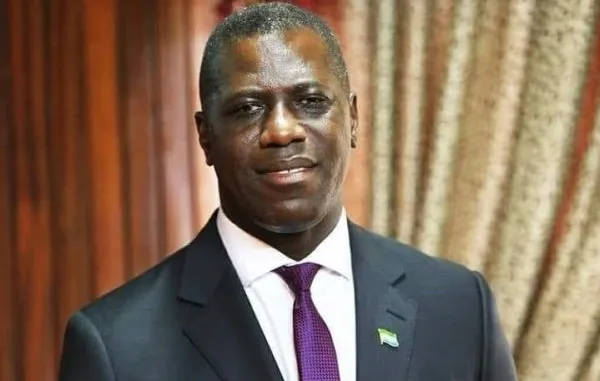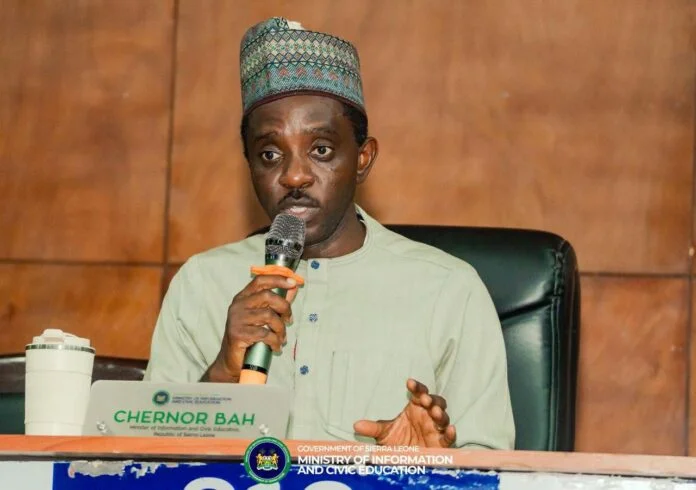
Sierra Leone's Minister of Information and Civic Education, Chernor Bah, recently dismissed a document circulating on social media regarding the European Parliament as "100 percent fake." The government maintains that the purported letter does not represent an official position of the European institution. Chernor Bah stated, "The European Parliament has 720 members. Anyone can write a letter or issue a statement. Until it is tabled, debated and resolved, it is not the position of the Parliament." He added, "So yes, the letter circulated, cited and I was asked about as from the European Parliament was and is 100 percent fake." The Minister of Information and Civic Education, Chernor Bah, firmly dismissed the document, which had gained traction across various social media platforms, as unequivocally "100 percent fake." He emphasized that the Government insists that the purported European Parliament letter does not constitute an official position of the institution, despite its widespread dissemination.
Details of Purported Document
The purported document falsely claimed to be an official communication from the European Parliament regarding Sierra Leone's alleged role as both a cocaine transit hub and a safe haven for convicted criminals originating from the European Union. This claim, which the Sierra Leonean government vigorously refutes, was central to the document's content. Dated 5 June 2026, the social media document was purportedly addressed to two key European Union officials. It was directed to Kaja Kallas, the European Union’s High Representative for Foreign Affairs and Security Policy, and Jozef Sikela, the European Commissioner for International Partnerships. The document called on the European Commission to utilize development funding and to consider potential sanctions. These measures were intended to encourage the extradition of suspected drug traffickers and to strengthen existing measures against transnational organised crime. The document also outlined specific demands for Sierra Leone to enhance its cooperation in international efforts against drug trafficking and organized crime. Its circulation caused considerable concern, prompting a swift response from the Sierra Leonean government. The false claims within the document painted a misleading picture of Sierra Leone's commitment to international law enforcement and its efforts to combat illicit activities.
Minister's Official Response
Chernor Bah responded to public concerns on Tuesday, June 9, 2026, addressing the circulating document. The Minister stated that any individual member of the European Parliament has the right to write a letter or issue a statement. However, he clarified that such a document does not become the official position of the Parliament unless it is formally tabled, debated, and adopted. Mr. Bah showed that the European Parliament is made up of 720 members, and individual actions do not necessarily reflect the institution's stance. He further explained that the process for an official European Parliament position involves rigorous parliamentary procedures, including committee review, plenary debate, and a formal vote, none of which had occurred for the document in question. The Minister consulted official channels to verify the document's authenticity and its implications for Sierra Leone. Following these consultations, he confirmed that no official action had been taken against Sierra Leone by the European Parliament. This confirmation provided key reassurance to the public and international partners, dispelling the unfounded allegations contained in the fake document. The Minister's proactive engagement with official European Union channels demonstrated the government's commitment to transparency and its efforts to counter misinformation.
Broader Context and Relations
The controversy surrounding the alleged European Parliament document emerges amidst recent international reports regarding a record cocaine seizure. This seizure was linked to a vessel that purportedly departed from West Africa. The timing of the fake document's appearance, coinciding with these international reports, raised questions about its potential intent to exploit existing narratives. Separately, the Government of Sierra Leone recently engaged in a public-private partnership with the European Union in Sierra Leone. This engagement focused on promoting investment and strengthening bilateral ties between the two entities. This productive public-private partnership engagement with the EU in Sierra Leone aimed at promoting investment and strengthening bilateral ties, stands in stark contrast to the unsubstantiated claims made in the fake document. The ongoing collaboration between Sierra Leone and the European Union shows a mutual commitment to development, security, and legitimate economic growth. The government continues to work closely with its international partners, including the European Union, on various initiatives that promote stability and prosperity in the region, further noting the baseless nature of the circulated document's accusations.