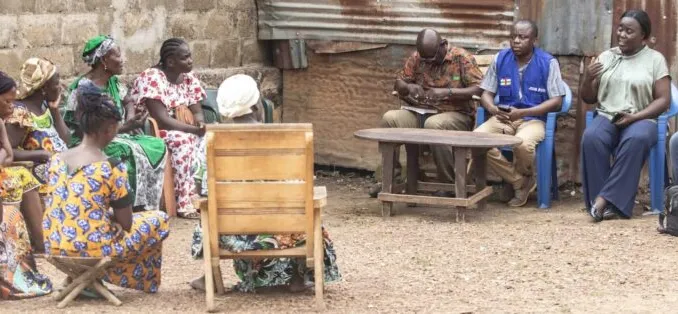
Women in Mobaye, Central African Republic, are transforming their collective savings into various projects aimed at improving their own lives and those of their families. This initiative notes a significant shift towards economic self-sufficiency and community-led development in the region. Through Village Savings and Loan Associations (VSLAs), 350 community members have pooled resources to fund small businesses and personal initiatives, demonstrating the power of collective action. These VSLAs provide a structured system for women to save money and access small loans, fostering economic independence and community development within Mobaye. The collective effort enables participants to invest in diverse ventures, ranging from agriculture to petty trade, thereby enhancing their livelihoods and contributing to the broader economic resilience of their households and the community. The success of these associations shows the potential for grassroots movements to drive sustainable change.
Seeds of Change in Mobaye
The impact of these savings associations is clearly visible in the daily lives of their members. Participants in the Ye Ti Maboko association, located in Mobaye’s Nzakara neighbourhood, regularly set aside 500 CFA francs each week, an amount equivalent to approximately USD 0.90. This consistent, collective saving mechanism allowed the group to accumulate nearly 600,000 CFA francs, or about USD 1,060, by the conclusion of their initial savings cycle. The accumulation of such a substantial sum through regular small contributions showcases the effectiveness of the VSLA model. Individual members then accessed these pooled funds for personal investments and needs, illustrating the direct benefit of their collective discipline.
The funds acquired through the VSLA have been instrumental in allowing women to pursue entrepreneurial ventures and address pressing household financial needs. Florence Passera, for instance, utilized 50,000 CFA francs, approximately USD 88, from the savings. She allocated this sum strategically to repay outstanding debts, thereby alleviating financial burdens, and to cover her children’s school fees, ensuring their continued access to education. Another member, Djamila Mahamat, leveraged 46,000 CFA francs, roughly USD 81, to significantly expand her existing doughnut business. The funds enabled her to diversify her operations by also starting a catering service, thus increasing her income streams and business resilience. Kaltouma Moustapha, a participant in the same association, invested her share in agricultural ventures, specifically establishing a poultry and duck farming enterprise, which contributes to local food security and provides a steady source of income. These individual successes collectively demonstrate the transformative power of accessible micro-financing.
The SEDOUTI Project's Impact
Supporting these grassroots efforts is the broader framework of the SEDOUTI Project, whose name translates to “Well-being” in Sango. This vital initiative receives funding from the United Nations Peacebuilding Fund, noting its importance in fostering stability and development in the region. The SEDOUTI Project integrates various components designed to support women in the region comprehensively. Its mandate combines direct assistance for women’s economic initiatives, providing the financial and practical resources needed for their ventures, with psychosocial support for participants, addressing the mental and emotional well-being of women who may have faced significant challenges. The project also focuses on strengthening social cohesion within communities, fostering a sense of unity and mutual support, and promoting more equitable relationships between women and men, striving for gender equality at the community level.
As part of these extensive efforts, a dedicated facility named Da Ti SEDOUTI, or “The Well-being House,” has been constructed. This building is equipped with four agro-processing machines, representing a significant investment in local infrastructure. The inclusion of such machinery is intended to further support local women's economic activities, particularly in the processing of agricultural products. By providing access to modern processing equipment, the project aims to enhance their entrepreneurial capacity, allowing them to add value to their produce and increase their market competitiveness. This directly contributes to the project's broader objectives of economic empowerment and community development in Mobaye, creating sustainable pathways for women’s economic advancement.
Building Confidence and Community
UN Women plays a key role in the expansion and sustainability of these financial initiatives, supporting 13 Village Savings and Loan Associations (VSLAs) in Mobaye. This support provides a strong framework for women to manage their finances collectively, fostering a sense of shared responsibility and mutual aid. The tangible benefits for individual members are clearly evident. Henriette Yambata, a participant in one such association, received 38,000 CFA francs, approximately USD 67, after several months of consistent saving, demonstrating the direct returns on her commitment. Yambata allocated a portion of these funds to cover school fees for her two children, ensuring their continued education and investing in their future. Another member, Elisabeth Yeti, invested a substantial 70,000 CFA francs, roughly USD 124, into agricultural activities. Yeti focused her investment on cultivating essential crops, including maize, cassava, and rice, thereby contributing significantly to her household's food security and generating income through sales. These examples show how collective saving and strategic investment are empowering women in Mobaye to build more secure and prosperous futures for themselves and their families, fostering both individual resilience and community growth.