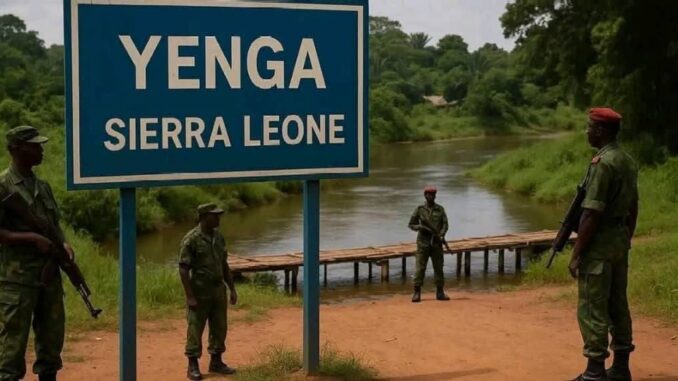
Sierra Leone received nine migrants deported from the United States on Wednesday, amid ongoing discussions regarding the status of the disputed Yenga territory and the nation's regional leadership role. The agreement facilitating the reception of these deportees is supported by a $1.5 million grant from the U.S. Government. According to reports, the village of Yenga remains under the control of Guinean authorities. President Julius Maada Bio currently serves as Chairman of ECOWAS, a role that places him at the forefront of regional diplomatic efforts. The arrival of the nine migrants on Wednesday marked a significant development in Sierra Leone's engagement with international migration policies, particularly those involving third-country deportation agreements.
Deportee Program Details
The recent group of deportees included five migrants from Ghana, two from Guinea, one from Senegal, and one from Nigeria. These individuals were part of a larger cohort of migrants subjected to deportation from the United States. Sierra Leone’s foreign minister, Timothy Kabba, informed local media Wednesday that the government had agreed to temporarily receive migrants deported by the Trump administration. He stated, "the government has agreed to temporarily receive migrants deported by the Trump administration, saying it only accepts West African nationals and the agreement is supported by a $1.5 million grant from the U.S. Government." This grant underpins the logistical and administrative framework required for the program's implementation.
Under the terms of the program, Sierra Leone is capped at receiving 25 deportees per month, with an annual limit of 300 individuals. Initially, 24 deportees were expected to arrive, indicating the potential for a larger intake than the nine who ultimately landed. Kenvah Solutions, a private contractor, was hired to manage the housing, food, and healthcare provisions for these individuals. This outsourcing of critical services notes the operational aspects of managing the temporary reception of deportees. Reports indicate that deportees are expected to be sent home to their countries of origin or transferred within 14 days of arrival, with provisions for extensions up to 30 days in exceptional circumstances. This stipulated timeline shows the temporary nature of their stay in Sierra Leone and the intention for onward movement.
The United States has established similar third-country deportation agreements with at least eight other African nations. These countries include Congo, Equatorial Guinea, South Sudan, Rwanda, Uganda, Eswatini, Ghana, and Cameroon. The existence of these multiple agreements suggests a broader strategy by the U.S. To manage deportations, particularly for individuals whose countries of origin may not readily accept their return or where direct deportation poses logistical challenges. The arrangement with Sierra Leone thus fits into a larger pattern of international cooperation on migration enforcement.
Yenga: A Lingering National Issue
The article reflects on the Sierra Leonean government's priorities, drawing a contrast between the apparent urgency to negotiate and implement agreements concerning deportees and the ongoing lack of resolution regarding the Yenga issue. This perspective suggests a disparity in the government's focus on different national matters. The Yenga dispute, a long-standing territorial disagreement with neighboring Guinea, continues to be a point of national contention and a subject of public scrutiny. The village of Yenga, located at the border between Sierra Leone and Guinea, has been under Guinean control for an extended period, despite Sierra Leone's claims to the territory.
For the author, the handling of Yenga represents a critical assessment of the nation's leadership, its commitment to national dignity, and the political will of its government. The unresolved status of Yenga is often cited by critics as an indicator of the government's efficacy in protecting national interests and asserting sovereignty. The territory's status continues to be a point of national discussion, noting broader questions about how Sierra Leone addresses its long-standing territorial disputes compared to newly emerging international arrangements. The perceived difference in the pace and determination applied to resolving the Yenga impasse versus the swift establishment of the deportee agreement raises questions about the administration's strategic priorities and its capacity to address complex, long-term national challenges. The Yenga issue, therefore, serves as a significant benchmark for evaluating the government's commitment to its territorial integrity and national pride.
Migrant Rights and Broader Context
The agreements facilitating the reception of deportees in Sierra Leone have prompted questions regarding the respect for migrants’ rights. Concerns have been raised previously about the legal protections afforded to individuals subject to such deportation arrangements, particularly when they involve third-country transfers. A U.S. Federal judge notably intervened in one case, halting a woman’s deportation to Sierra Leone after determining that the government had not allowed her to seek protection under the Convention Against Torture. This judicial action showed issues related to due process for individuals facing removal, emphasizing the importance of legal safeguards even in deportation proceedings. The judge's decision noted potential vulnerabilities in the deportation process where individuals might be denied the opportunity to claim asylum or protection under international human rights treaties.
Similarly, a federal judge ordered the Trump administration to return a Colombian woman to the U.S. From Congo. She had been deported there despite Congo having refused to accept her due to its inability to manage her medical needs, noting challenges in the implementation of third-country agreements. This case illustrates the practical and ethical complexities that can arise when countries are designated as temporary receiving points for deportees, especially when the receiving country's capacity or willingness to accept individuals is compromised. The incident with the Colombian woman further accentuates the need for rigorous vetting and humanitarian considerations in such agreements, ensuring that individuals are not placed in situations where their basic needs or rights cannot be met. These judicial interventions serve as critical reminders of the legal and human rights implications inherent in international deportation programs, prompting closer scrutiny of the agreements Sierra Leone has entered into. The broader context of these judicial rulings suggests a growing international awareness and concern for the rights of individuals caught in the complex web of global migration and deportation policies.