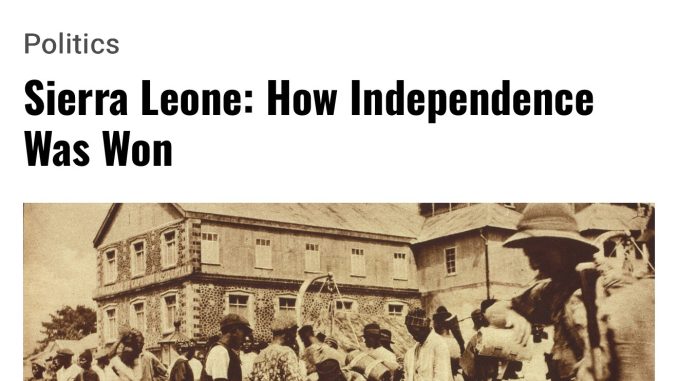
Sierra Leone achieved independence from Britain on April 27, 1961, with Sir Milton Margai leading the nation. This key moment on April 27, 1961, marked the end of British colonial rule and the birth of a sovereign Sierra Leone. As the nation embarked on its new journey, Sir Milton Margai, who would serve as Sierra Leone’s first prime minister, urged citizens to "deal fairly and honestly with your fellow men, to discourage lawlessness, and to strive actively for peace, friendship, and unity in our country." His words showed the aspirations for a harmonious and just society. The West African nation, located in the rainforest region, covers 27,699 square miles and has an estimated population of 6.5 million. It is a constitutional republic made up of three provinces and a Western Area, which are further divided into 14 districts. Three national elections — presidential, legislative, and local government — were scheduled for the year following the article's publication, noting the country's ongoing commitment to democratic processes.
Forging a Nation
Before independence, tensions existed between the "countrymen" from Sierra Leone's inland "protectorate" and the Krios residing in the Western Area. These antagonisms escalated following proposals in 1947 for a single political system, which aimed to diminish the political power of the Krios. The antagonism between the "colony" and "protectorate" became particularly pronounced over these proposals. Isaac Wallace-Johnson led Krio opposition to these 1947 proposals, advocating for the preservation of Krio political influence.
Sir Milton Margai, whose family name was Tu-borku Metzeger, emerged as a significant figure by winning over both the educated protectorate elite and critical chiefs. Sir Milton Margai, son of Tu-borku Metzeger, skillfully navigated the political landscape, using his abilities to gain the support of opposition leaders and moderate Krio elements, which was key for the independence movement. His adept political maneuvering was instrumental in uniting disparate factions under a common goal of self-determination. Sir Milton supervised the drafting of a new constitution in November 1951, a key step that united the legislatures of the colony and the protectorate, laying the groundwork for a unified national government.
The country was granted local ministerial powers in 1953, a significant step towards self-governance. In the same year, Sir Milton was elected as "chief minister" of Sierra Leone, further solidifying his leadership role in the pre-independence administration. Sierra Leone held its first parliamentary election in May 1957, which was won by the Sierra Leone People's Party (SLPP). Following this victory, Sir Milton was re-elected as chief minister in 1957, demonstrating continued public confidence in his leadership. A constitutional conference, known locally as the Constitutional Talks, was held in London, where Sir Milton led a delegation in 1960 to finalize the arrangements for independence. This conference was the culmination of years of political negotiation and preparation. Upon achieving independence, Sir Milton Margai called upon citizens to "deal fairly and honestly with your fellow men, to discourage lawlessness, and to strive actively for peace, friendship, and unity in our country," reiterating his vision for the newly independent nation.
Early Years and Political Turmoil
Sir Milton Margai was sixty-six years old at the time of Sierra Leone's independence, bringing a wealth of experience to the nation's highest office. His leadership guided the country through its initial years of sovereignty. He died in 1964, just three years after leading Sierra Leone to independence. Following his death, his younger brother, Sir Albert Margai, subsequently took over as premier. This succession marked a new chapter in Sierra Leonean politics. The Sierra Leone People’s Party (SLPP) lost the 1967 elections, leading to Siaka Stevens of the All People’s Congress (APC) gaining power, signifying a shift in the political landscape.
The Royal Sierra Leone Military Forces, under Brigadier David Lansana, staged the country’s first coup d’état within hours of the 1967 election results, plunging the nascent democracy into instability. Senior military officers divested Brigadier Lansana of his command within 24 hours of the first coup, attempting to restore order. However, the National Reformation Council (NRC) was instituted following this initial coup, indicating continued military involvement in governance. Thirteen months later, a second coup d’état, executed by non-commissioned officers, occurred, further disrupting the political order. Siaka Stevens regained the premiership after the second coup, marking a turbulent return to civilian rule following a period of military interventions.
During the independence preparations, the colonial secretary Iain Macleod represented the British government at the 1960 talks, overseeing the transfer of power. Earlier, Siaka Stevens and Isaac Wallace-Johnson had been placed under house arrest in Freetown, charged with disrupting the independence movement, a testament to the intense political climate of the era. Sir Milton Margai had previously called upon citizens to "deal fairly and honestly with your fellow men, to discourage lawlessness, and to strive actively for peace, friendship, and unity in our country." His tenure was followed by a period of significant political instability and military interventions that reshaped the nation's leadership. The rapid succession of coups noted the fragility of the nascent democratic institutions in the immediate post-independence era, showing the challenges faced by the young nation. These events marked a turbulent beginning for Sierra Leone, contrasting sharply with the hopes for unity and stability expressed at independence.
A History of Resilience
The indigenous Mende people referred to their country as Romarong, reflecting a deep historical connection to the land. Archaeological findings indicate continuous human habitation in the territory for at least 2,500 years, pointing to a rich and ancient past. In 1462, the Portuguese explorer Pedro da Cintra mapped the hills surrounding Freetown Harbour, naming the formation Serra de Leão, which later evolved into Sierra Leone. A Portuguese fort was subsequently constructed at Freetown Harbour in 1495, marking an early European presence in the region.
Centuries later, in 1562, Sir John Hawkins transported 300 African slaves to British colonies in America, illustrating the early involvement of European powers in the transatlantic slave trade from the West African coast. English traders established a settlement named "Province of Freedom" in Sierra Leone in 1787, intended as a haven for freed slaves. The Sierra Leone Company was founded in March 1792 with the objective of relocating 1,196 black Americans, further contributing to the unique demographic and historical development of Freetown. Britain assumed control from the Sierra Leone Company when Freetown became a British "crown colony" in 1808, solidifying its colonial administration.
Educational institutions also emerged, with Fourah Bay College established in Freetown in 1827, becoming the first Western-style university in West Africa and a significant center for learning. The interior of the country was designated a British "protectorate" in 1896, extending British influence beyond the coastal colony. This period saw resistance to colonial rule, notably the "Hut Tax War" which took place in 1898, a direct challenge to British authority and taxation policies. Bai Bureh led the "northern front" of the conflict during the "Hut Tax War," emerging as a prominent figure in the resistance movement. His leadership galvanized opposition to colonial impositions, demonstrating the enduring spirit of defiance among the local populations.
Contemporary Struggles and Ideals
Sir Milton Margai served as Sierra Leone’s first prime minister, having urged citizens to "deal fairly and honestly with your fellow men, to discourage lawlessness, and to strive actively for peace, friendship, and unity in our country." His vision for a unified and peaceful nation continues to resonate. Sierra Leone later experienced an 11-year rebel war from 1991 to 2002, a devastating conflict that profoundly impacted the country and its people. The nation's history includes figures like Bai Bureh, who was captured on November 11, 1898, and subsequently sent into exile in what is now Ghana, a stark reminder of the consequences of resisting colonial power. Tragically, ninety-six of Bai Bureh's colleagues were hanged by the British, noting the brutal suppression of the "Hut Tax War."
In 1935, the British granted De Beers a mineral mining monopoly, initially planned to last 98 years, establishing a long-term economic arrangement that shaped the country's resource extraction industry. Today, Sierra Leone is recognized among the top 10 diamond producers globally, with its mineral wealth being both a source of potential prosperity and historical conflict. The country comprises sixteen ethnic groups, with the Mende and Temne being the two largest, contributing to a rich cultural tapestry. Sierra Leone is predominantly Muslim but also has a significant Christian minority, reflecting a diverse religious landscape where both faiths coexist. Divisive politics, often based on ethnicity and regionalism, remains a tough challenge facing Sierra Leone, hindering national cohesion and development. The opposition has claimed the Koroma government shows “discrimination” against people from the south-east, indicating ongoing political tensions and concerns about equitable governance. These contemporary struggles show the persistent challenges Sierra Leone faces in fully realizing the ideals of unity and peace articulated at its independence.