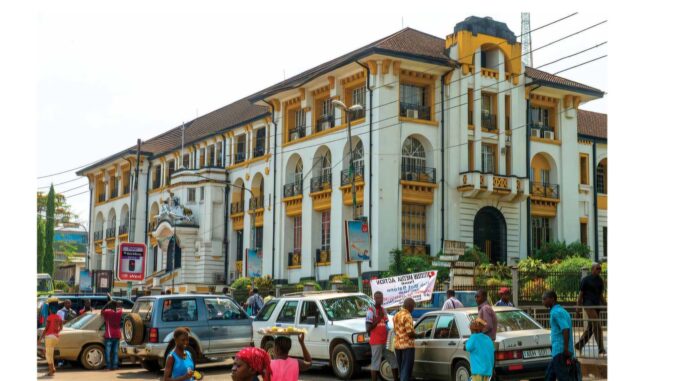
The Supreme Court of Sierra Leone struck out a motion filed by the Attorney General and Minister of Justice on 21 October 2026. This legal action followed a request by the Attorney General to dismiss a constitutional reference currently before the court. The underlying constitutional reference concerns the specific procedure required for amending non-entrenched provisions of the 1991 Constitution. By rejecting the motion, the court maintains the current standing of the constitutional challenge. The proceedings remain active as the court addresses the questions regarding legislative amendment processes. The Attorney General's motion specifically sought to dismiss this constitutional reference regarding the procedure for amending non-entrenched provisions of the 1991 Constitution.
Court Rules on Jurisdiction
Chief Justice Kabombeh Pen presided over the ruling and declared that the Supreme Court of Sierra Leone lacked the necessary jurisdiction to entertain the motion submitted by the Attorney General and Minister of Justice. The Chief Justice ruled that the Supreme Court lacked jurisdiction to entertain the motion. Legal counsel present during the session heard the Chief Justice explain that the court could not grant the request to dismiss the active constitutional challenge, as the legal framework did not provide the authority to hear such an application under the current circumstances.
Chief Justice Kabombeh Pen characterized the filing as an attempt to forestall proceedings after the court had already issued formal directions for the case. The Chief Justice described the motion as an attempt to forestall proceedings after directions had already been issued. The bench noted that the timing of the motion conflicted with the established procedural schedule, which had already moved past the stage where such a dismissal could be considered. By rejecting the motion on jurisdictional grounds, the court signaled that the existing timeline for the constitutional reference will proceed as previously ordered.
The underlying constitutional matter before the justices involves the interpretation and application of Sections 91 and 108 of the 1991 Constitution. The constitutional matter involves Sections 91 and 108 of the 1991 Constitution and the enactment of the 2026 Constitutional Amendment. These provisions dictate the legal requirements and procedures governing how amendments to the supreme law of Sierra Leone must be enacted. The case specifically examines whether the enactment of the 2026 Constitutional Amendment adhered to these constitutional mandates. Parties involved in the litigation are now expected to continue their arguments regarding the legitimacy of the legislative process used to implement the 2026 Constitutional Amendment, while the court focuses on whether those actions align with the requirements set forth in Sections 91 and 108. The court will continue to evaluate the legal arguments presented by all parties concerning the 2026 Constitutional Amendment and its compliance with the established constitutional framework.