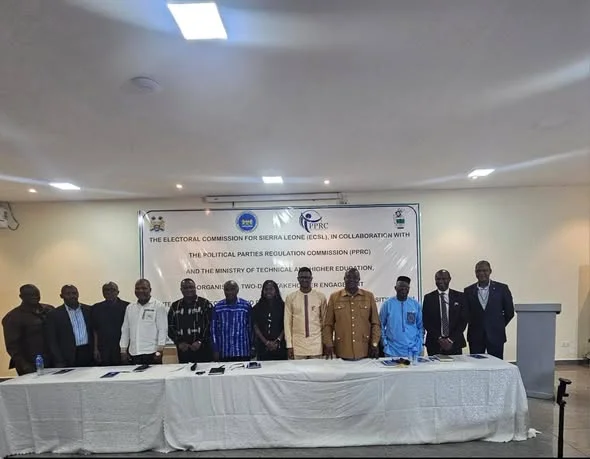
The Electoral Commission for Sierra Leone (ECSL) recently concluded a two-day stakeholders’ engagement in Freetown, focusing on electoral reforms. The engagement took place from June 11 to June 12, 2026. The forum, held in collaboration with the Political Parties Regulation Commission (PPRC) and the Ministry of Technical and Higher Education, brought together various parties to discuss recommendations for improving the country's electoral processes. A key outcome from the engagement is a report advocating for the integration of governance and electoral studies into the curricula of schools and universities. This initiative, specifically aiming to integrate Electoral Administration and Political Education into Sierra Leone's university system, seeks to enhance public understanding and participation in democratic and electoral affairs from an early stage.
Rationale for Integration
The proposed curriculum aims to broaden access to expertise in election management, legal frameworks, logistical systems, and ethical standards across Sierra Leone. Integrating political education into university programmes would help foster a culture of electoral integrity by promoting tolerance, non-violence, and respect for the rule of law among students and future leaders. This approach is designed to produce a well-informed citizenry capable of engaging meaningfully with democratic processes.
The proposed curriculum would broaden access to expertise in key areas such as election management, the intricate legal frameworks governing elections, the logistical systems required for their successful execution, and the ethical standards expected of all participants. An educated electorate is considered the strongest defense against misinformation, electoral manipulation, and political apathy, according to the recommendations. The initiative posits that democracy is a learned behavior sustained by knowledge, values, and habits passed from one generation to another, showing the importance of early and continuous civic education. This approach seeks to embed democratic principles more deeply within society, ensuring that future generations are equipped with the understanding and values necessary to uphold a strong democracy.
Moving from Recommendation to Action
The stakeholder engagement that discussed electoral reform and curriculum integration occurred from June 11 to June 12, 2026. This two-day event brought together representatives from the Electoral Commission for Sierra Leone (ECSL), the Political Parties Regulation Commission (PPRC), and the Ministry of Technical and Higher Education to deliberate on the proposed changes. The discussions culminated in recommendations for integrating governance and electoral studies into educational curricula. The report advocates the inclusion of governance and electoral studies in school and university curricula.
The initiative to reform university curricula is specifically anchored in Recommendation 13 of the Cross-Party Committee Report on Electoral Systems and Management Bodies’ Review. This foundational document provides the framework and justification for the proposed educational reforms, aiming to enhance the knowledge base and ethical standards within Sierra Leone's electoral processes. By linking the curriculum changes to this specific recommendation, the ECSL and its partners are working to implement a structured approach derived from a full review of the nation's electoral landscape. This strategic alignment ensures that the educational reforms are not isolated but are part of a broader, well-considered effort to strengthen the country's democratic institutions.
Expertise and Collaboration
The initiative seeks to integrate Electoral Administration and Political Education into Sierra Leone's university system. This integration aims to professionalise democracy, strengthen electoral integrity, enhance citizen participation, and contribute to peaceful and credible elections for future generations. Embedding electoral administration and political education in the university system would help professionalise democracy, strengthen electoral integrity, enhance citizen participation, and contribute to peaceful and credible elections for generations to come.
Modern electoral processes are increasingly complex, encompassing various critical issues. These include voter education, the deployment and management of electoral technology, election security protocols, and the regulation of campaign financing. Additionally, electoral systems must address dispute resolution mechanisms, combat misinformation, ensure gender inclusion, and encourage youth participation, all while maintaining overall electoral integrity. Modern electoral processes have become increasingly complex, involving issues such as voter education, electoral technology, election security, campaign financing, dispute resolution, misinformation, gender inclusion, youth participation, and electoral integrity. The proposed curriculum aims to equip students with the full understanding and skills needed to navigate these complexities, thereby fostering a new generation of professionals and citizens capable of contributing positively to Sierra Leone's democratic future.