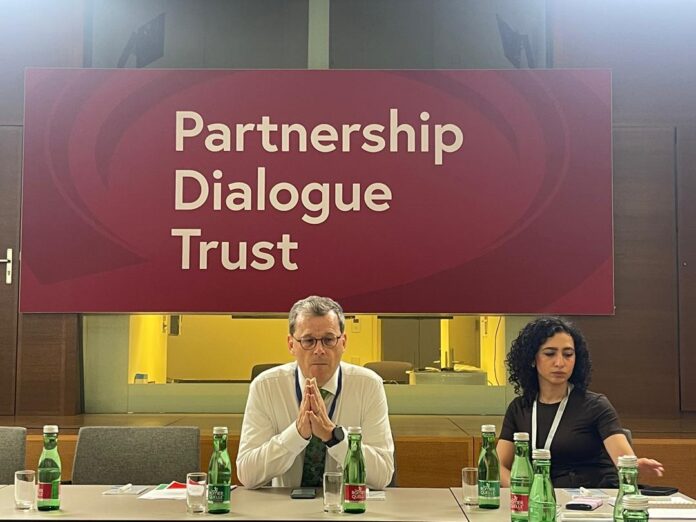
Senior officials from the Austrian Federal Ministry for European and International Affairs engaged African journalists participating in the Austrian-African Media Fellowship Programme in Vienna. A high-level briefing was held at the Austrian Foreign Ministry on Monday, 18 May 2026. During the session, Foreign Ministry officials outlined Austria’s communication philosophy, diplomatic priorities, and campaign for election to the United Nations Security Council for the 2027–2028 term. This engagement provided a valuable platform for direct interaction between Austrian diplomats and media representatives from across the African continent, fostering mutual understanding and noting Austria's commitment to global cooperation.
Campaign for UNSC Seat
Austria is actively campaigning for election to a non-permanent seat on the United Nations Security Council for the 2027–2028 term. This bid was noted during a briefing for African journalists at the Austrian Federal Ministry for European and International Affairs. The country aims to secure one of the rotating seats, which provides member states with significant influence over global peace and security matters. Austria's pursuit of this prestigious position shows its dedication to multilateralism and its desire to play a more prominent role in addressing pressing international challenges.
The European nation is pursuing this Security Council position alongside two other European countries, Germany and Portugal. All three nations are contending for the non-permanent seats available during the upcoming election cycle. The competition for these coveted roles typically involves intensive diplomatic efforts and outreach to other UN member states, as each country seeks to garner sufficient support from the broader UN membership. Austria's campaign emphasizes its long-standing commitment to international law, human rights, and peaceful conflict resolution, positioning itself as a reliable and experienced partner on the global stage.
The official voting process for the United Nations Security Council seat is anticipated to occur in June. Delegates from member states will cast their ballots at the United Nations headquarters located in New York. The outcome of this vote will determine which countries will serve on the Security Council for the designated 2027–2028 term, influencing global policy and security decisions for the two-year period. This election represents a critical moment for Austria's diplomatic ambitions, with significant resources and diplomatic capital invested in securing the necessary votes.
Diplomacy and Communication Strategy
Austria’s Ministry of Foreign Affairs has adopted a dual communication strategy designed to effectively engage both domestic and international audiences. This approach ensures that the country's diplomatic efforts and policy objectives are disseminated widely across various platforms. The international communication strategy, in particular, is strongly centered on principles of trust, dialogue, and openness, according to officials. These core tenets guide Austria's interactions with other nations and international bodies, fostering transparent exchanges and building stronger diplomatic relationships. This strategy is key for conveying Austria's foreign policy priorities and its vision for a more peaceful and secure world.
The nation continues to work alongside its European partners to strengthen collective resilience against misinformation. This collaborative effort addresses the challenges posed by the spread of false narratives and aims to safeguard the integrity of public discourse, both domestically and internationally. The proactive stance against misinformation is considered vital in an increasingly complex information environment, where accurate and reliable communication is critical for maintaining stability and fostering informed decision-making. Austria’s consular support services for citizens abroad are described as one of the country’s strongest diplomatic achievements. These services provide essential assistance and protection to Austrian nationals in other countries, noting a commitment to citizen welfare as a key aspect of its foreign policy. The strong consular network plays a significant role in maintaining the safety and well-being of its citizens globally, reflecting a full approach to international engagement that prioritizes both national interests and humanitarian concerns.
Vienna's Global Role
Vienna serves as one of the four principal headquarters of the United Nations globally, alongside New York, Geneva, and Nairobi. This position shows the city's importance in international diplomacy and its role as a nexus for multilateral cooperation. Additionally, Vienna hosts more than forty international organizations, further solidifying its status as a global hub for international relations. Among these organizations, the International Atomic Energy Agency (IAEA) is headquartered in Vienna, playing a key role in nuclear non-proliferation and peaceful nuclear technology, demonstrating the city's contribution to critical global issues. The city's international environment is currently being experienced by ten journalists from different African countries who are participating in the Austria Africa Media Fellowship Programme. This initiative provides these journalists with firsthand exposure to Austria's diplomatic landscape and its contributions to global governance, enhancing their understanding of international affairs and fostering professional connections.
Broader Diplomatic Context
Austria’s longstanding neutrality and extensive diplomatic experience position the country uniquely to contribute meaningfully to international peace and security efforts. This perspective is a key component of its foreign policy, allowing it to act as a bridge-builder and facilitator in complex international negotiations. Its history of neutrality, combined with its active participation in international organizations, provides a credible foundation for its diplomatic initiatives. Democratic societies globally increasingly face efforts intended to undermine public confidence and create distrust in public institutions. This challenge necessitates strong national and international responses, which Austria is committed to addressing through its multilateral engagements and its efforts to promote transparent communication and foster trust. The country’s approach emphasizes the importance of international cooperation in confronting shared global challenges, from security threats to the erosion of democratic values.