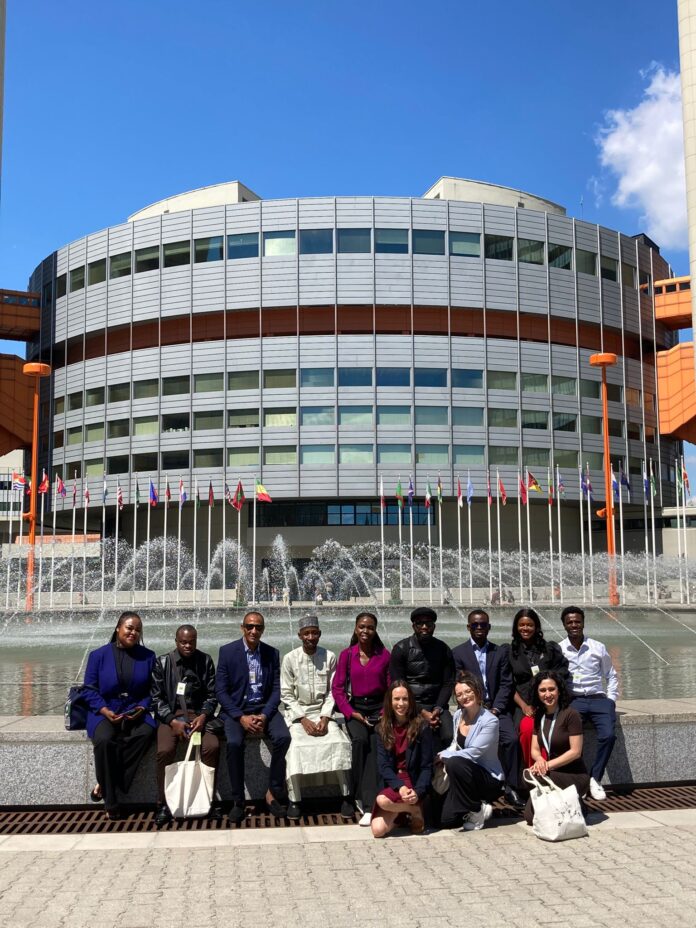
Ten journalists from various African nations participated in the Austria-Africa Media Fellowship Programme on Monday, May 18, 2026. This significant event brought together media professionals from across the continent for an immersive experience designed to foster greater understanding of international organizations and their impact. As a key part of their itinerary, the esteemed group visited the headquarters of the International Atomic Energy Agency (IAEA) at the Vienna International Centre in Vienna, Austria. The fellowship, meticulously organized to facilitate direct interaction with key institutions in Austria, provided these journalists with a unique opportunity. Their visit to the IAEA offered an invaluable chance to learn firsthand about the agency's multifaceted work and its profound contributions to global development across numerous critical sectors. The programme aimed to enhance reporting capabilities on complex international issues by providing direct access to the organizations shaping global policy and progress.
IAEA's Mission and Structure
The International Atomic Energy Agency (IAEA) holds a key position in the global landscape, having been established in 1957. Since its inception, it has operated as an autonomous body within the United Nations system, tasked with promoting the peaceful uses of nuclear energy while preventing its use for any military purpose. During the visit, Sinéad Harvey, a distinguished Press and Public Information Officer in the Office of Public Information and Communication, played a key role in engaging with the visiting journalists. Ms. Harvey delivered an insightful briefing that shed light on the agency's extensive work and its broad global engagement efforts. Her full presentation covered the IAEA's broad mandate, which encompasses a wide array of activities from nuclear safety and security to verification and the application of nuclear science for sustainable development. She detailed the diverse activities undertaken worldwide, emphasizing the agency's commitment to assisting its member states in harnessing nuclear technology for beneficial purposes.
Following Ms. Harvey's detailed overview, Michel Warnau, who serves as the Section Head in the Division for Africa under the Department of Technical Cooperation, delivered a full lecture. Mr. Warnau's presentation was instrumental in outlining the agency’s intricate organizational structure and detailing its strong technical cooperation mechanisms. He elaborated that the IAEA operates through six distinct departments, a structure designed to efficiently manage its diverse responsibilities. These departments notably include four major technical divisions, each focusing on specialized areas of nuclear science and technology. Mr. Warnau particularly emphasized the member state-driven nature of the Technical Cooperation Programme, noting it as a cornerstone of the IAEA's operational philosophy.
During his address, Mr. Warnau unequivocally stated, "The Technical Cooperation Programme is entirely member state-driven." He further expounded on this critical approach, explaining that it ensures both the relevance and the maximum impact of the IAEA's initiatives. He remarked, "Countries identify their own national priorities, which the agency then supports through carefully designed projects aligned with development goals." This careful process allows the IAEA to provide highly tailored assistance, ensuring that resources and expertise are directed towards areas identified as most critical by its member states. This collaborative framework is designed to effectively help countries achieve their specific development objectives, ranging from health and agriculture to water management and environmental protection, all through the responsible application of nuclear science and technology.
Technical Cooperation in Africa
The African region stands as a major and significant beneficiary of the IAEA’s Technical Cooperation Programme, showing the agency's commitment to supporting development across the continent. Last year alone, approximately 50 African member states received substantial support under this vital programme, demonstrating its widespread reach and impact. The programme has also seen recent expansion, welcoming new participants such as Guinea, Somalia, and The Gambia, further broadening its collaborative network. To enhance regional collaboration and maximize the benefits of nuclear science and technology, the African Regional Cooperative Agreement for Research, Development and Training Related to Nuclear Science and Technology (AFRA) was established in 1990. AFRA plays a key role in fostering knowledge exchange and coordinated efforts among African nations.
By the end of last year, the agency recorded an impressive figure of about 197 active national and regional projects spanning across the African continent. These projects cover a wide spectrum of applications, from improving agricultural yields to enhancing medical diagnostics and environmental monitoring. The commitment to capacity building is evident in the agency's training initiatives; in 2025, the IAEA organized 32 regional training courses throughout Africa. These courses were designed to equip local professionals with advanced skills and knowledge in various nuclear applications. Complementing these training efforts, the agency also deployed 563 experts and lecturers for technical missions and specialized training sessions during the same year, providing direct, on-the-ground support and expertise.
The IAEA significantly invested in human resource development, with over 800 fellows and scientific visitors from Africa receiving invaluable overseas training opportunities in 2025. These opportunities allowed African professionals to gain exposure to advanced research and technologies in leading institutions worldwide. In total, approximately 1,400 participants took part in various training activities facilitated by the IAEA, with a notable and encouraging statistic revealing that women accounted for nearly 1,000 of these participants. This notes the agency's dedication to promoting gender equality and empowering women in science and technology. A particularly significant initiative, the Rays of Hope programme, was launched in 2022 with the ambitious aim of improving cancer diagnosis and radiotherapy services across Africa. This programme directly addresses the critical need for advanced medical treatments on the continent, where current estimates indicate a severe disparity: nearly 70 percent of Africans currently lack access to radiotherapy treatment. The Rays of Hope programme is a concerted effort to bridge this gap, enhancing healthcare infrastructure and saving lives through the application of nuclear medicine.
Nuclear Science for Global Challenges
The International Atomic Energy Agency (IAEA) consistently employs nuclear science applications as a powerful tool to address pressing global challenges that impact communities worldwide. Among these, food security and environmental protection stand out as areas where nuclear techniques offer unique and effective solutions. The Atoms4Food initiative, for example, directly addresses the complex issues of food insecurity and agricultural challenges by leveraging advanced nuclear techniques. This full program aims to enhance agricultural productivity, improve crop resilience, and ensure food safety in member states through innovations such as mutation breeding, pest control, and soil and water management studies. By helping countries produce more food more sustainably, Atoms4Food contributes significantly to global efforts to combat hunger and malnutrition.
Another significant global initiative is NUTEC Plastics, which strategically utilizes nuclear techniques to combat the widespread problem of marine and terrestrial plastic pollution. This innovative program focuses on developing sustainable solutions for plastic waste management and recycling, offering a scientific approach to a growing environmental crisis. Current estimates show the severity of this challenge, indicating a staggering presence of approximately one ton of plastic for every three tons of fish in the ocean. The NUTEC Plastics initiative seeks to mitigate this alarming trend by promoting innovative approaches to plastic waste reduction, enhancing recycling processes, and exploring new biodegradable materials through nuclear technologies. This effort is key for protecting marine ecosystems and ensuring a healthier planet.
In response to the global health crisis, the IAEA launched the ZODIAC initiative during the height of the COVID-19 pandemic. This critical program was established with the primary objective of strengthening countries' capacities to detect, monitor, and rapidly respond to zoonotic diseases – illnesses that can transmit from animals to humans. ZODIAC provides a strong global network for surveillance and research, leveraging nuclear and nuclear-derived techniques for rapid pathogen detection and characterization. By improving early detection and developing rapid response mechanisms, ZODIAC plays a vital role in helping to prevent future pandemics and safeguarding global public health. These initiatives collectively demonstrate the IAEA's unwavering commitment to applying nuclear science not just for energy, but also as a powerful force for global good, tackling some of humanity's most urgent problems.