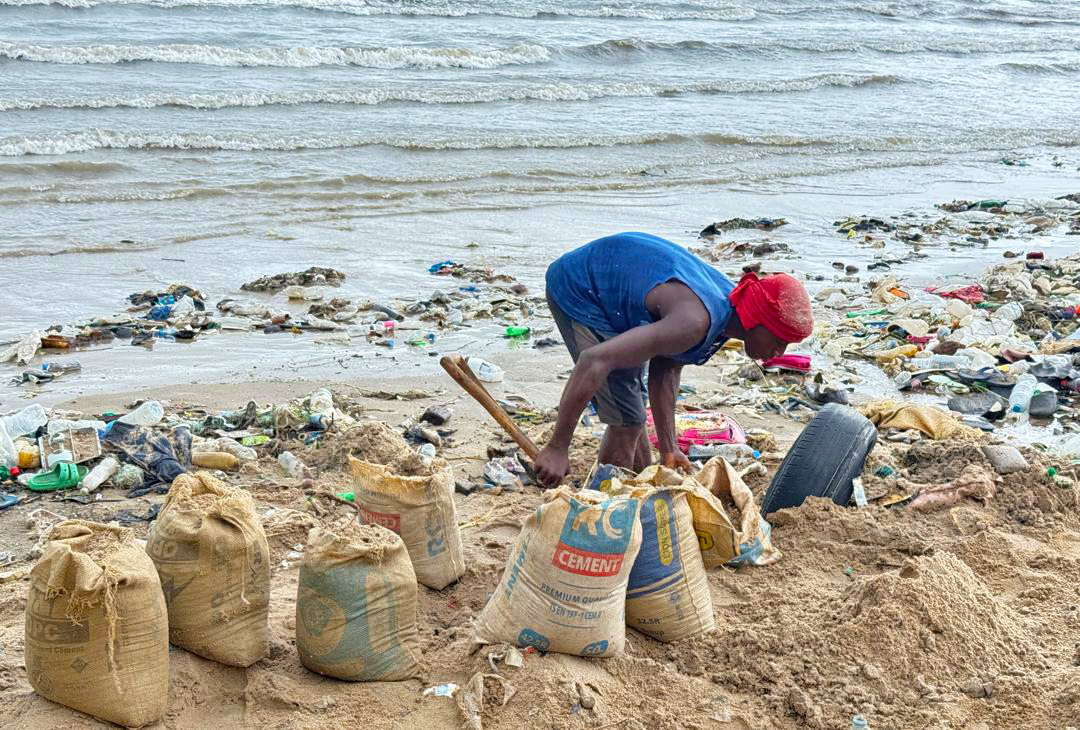
Approximately 50,000 cubic meters (1.8 million cubic feet) of sand are extracted annually from Mahera Beach in Sierra Leone. This industrial-scale removal of sediment has begun to alter the local environment, according to those working on the coast. Aminata Kargbo, chairperson of the sand sellers in Mahera, stated, "Since we started three years back, the changes have affected the way water moves on the beach area." Regarding the economic necessity of the trade, she noted, "Most of these women have lost their husbands, and the money we make goes to support our children." Abdulai Conteh, a sand miner and loader, emphasized the potential social consequences of halting the practice. He said, "If sand mining is stopped, stealing could increase. Right now, many young people depend on this work."
Economic Lifeline for Families
Individual sand shovelers operating on the beach earn 2 leones, equivalent to $0.08, for every bag of sand they fill. These laborers typically manage to carry between 20 and 30 bags during a single day of work. The physical labor required to move these bags from the shoreline to transport vehicles is intense, yet it remains a primary source of income for many residents living in the immediate vicinity of the coast. For those involved in the daily extraction process, the 2 leones earned per bag represent the fundamental means of purchasing food and basic necessities for their households.
Construction projects within the country represent the primary driver of this demand, accounting for 61% to 77% of all sand use in Sierra Leone. As urbanization continues to expand, the reliance on raw materials sourced from coastal areas like Mahera Beach has grown significantly. Within this broader market, the Mahera-Lungi corridor serves as a localized production hub, meeting approximately 8% of the national demand for sand. This specific corridor has become a central point for logistics, where sand is collected, stockpiled, and then loaded onto trucks destined for various building sites throughout the region.
The World Bank assessment report details the broader environmental consequences of these operations. The findings indicate that coastal sand extraction disrupts natural sediment flows, increases erosion, and causes damage to ecosystems and tourism assets. The report notes that the removal of sand at this scale interferes with the beach's natural ability to replenish itself, which in turn accelerates the degradation of the shoreline. By altering the physical composition of the beach, the extraction process creates lasting impacts on the coastal geography. These environmental shifts present a complex challenge, as the immediate economic needs of the local workforce are balanced against the long-term sustainability of the area’s natural resources and the potential for tourism development. The World Bank assessment report shows that without careful management, the continued extraction of sand at the current volume will likely lead to further loss of biodiversity and the degradation of valuable coastal land.