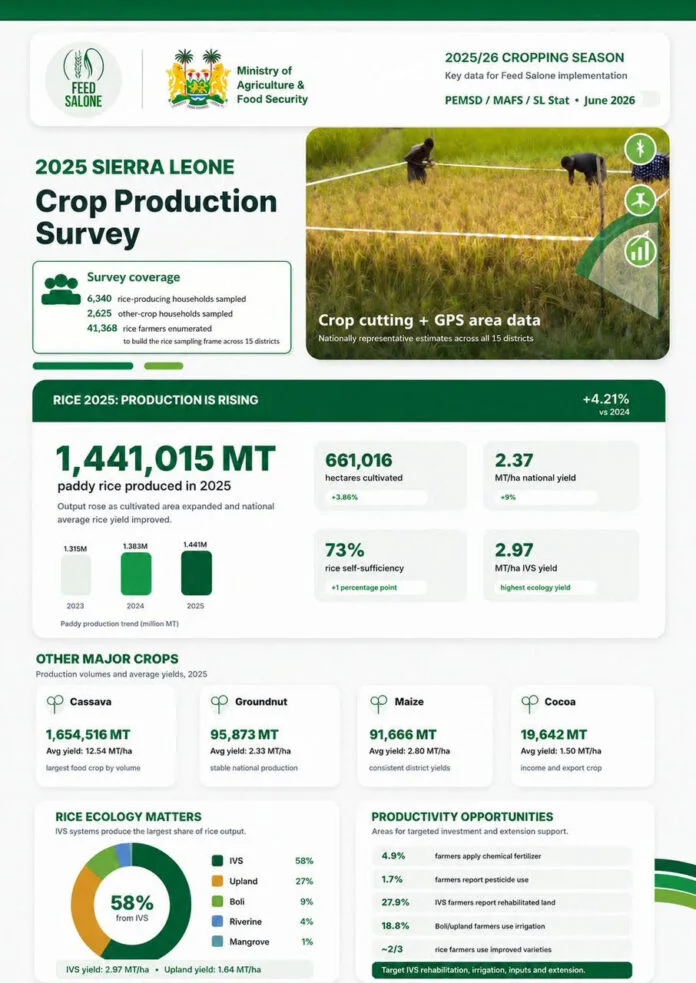
Sierra Leone's agricultural sector has demonstrated significant progress in 2025, particularly in rice production, which is a cornerstone of the nation's food security strategy. This positive trend is detailed in the 2025 Sierra Leone Crop Production Survey, which was published on 26 June 2026. The full survey was conducted in partnership with the Planning, Evaluation, Monitoring and Statistics Division (PEMSD) and Statistics Sierra Leone, providing a strong analysis of the country's agricultural output.
Rice Production Details
Sierra Leone's total rice production is projected to reach 1,568,668 metric tonnes in 2025. This figure represents the total quantity of rice produced across all cultivation methods. Within this total, the production of paddy rice, the raw form of rice before milling, reached 1,441,015 metric tonnes in 2025. This marks a substantial 4.21 percent increase over the previous year's output, noting a consistent upward trajectory in the nation's staple food production. This notable growth in production has directly contributed to an improvement in the country's food self-sufficiency, with rice self-sufficiency increasing to 73 percent in 2025, up from 72 percent in the previous year.
Farmers across Sierra Leone dedicated approximately 661,016 hectares for rice cultivation in 2025. This expanded land use signifies a 3.86 percent increase in cultivated area compared to 2024, demonstrating an intensified focus on rice farming. The national average rice yield also saw a notable improvement, increasing by 9 percent to 2.37 metric tonnes per hectare. This improvement in yield indicates more efficient farming practices and potentially better crop management.
Inland Valley Swamp (IVS) farming emerged as a significant contributor to this success, accounting for 58 percent of the national rice production. This method of cultivation proved particularly productive, with IVS farming recording the highest average yield among all cultivation methods, reaching an impressive 2.97 metric tonnes per hectare. The effectiveness of IVS farming shows its potential for further development and investment. Upland farming also played a key role, contributing 27 percent to the total rice production for the year. The growth in both overall production and average yield across these methods shows the concerted efforts within the agricultural sector to enhance food output and move towards greater food security.
Broader Agricultural Landscape
Beyond rice, Sierra Leone's agricultural sector demonstrated varied output across other key crops in 2025, reflecting a diversified approach to food production. Cassava production reached 1,654,516 metric tonnes, making it a substantial contributor to the nation's food supply and a vital source of calories for many communities. Groundnut production also played a significant role in the agricultural landscape, with a total of 95,873 metric tonnes harvested. These legumes are important for both nutrition and as a source of income for farmers.
Maize production for the year stood at 91,666 metric tonnes, further diversifying the country's cereal output. The country's cocoa production, an important cash crop with significant export potential, totaled 19,642 metric tonnes. These figures reflect the broader agricultural activity in Sierra Leone alongside the significant growth observed in rice cultivation. The diversification in crop output contributes to the overall stability and self-sufficiency goals of the nation's agricultural strategy, reducing reliance on a single crop and enhancing resilience against environmental and market fluctuations.
Challenges and Recommendations
Despite the encouraging improvements in overall agricultural production, the 2025 Sierra Leone Crop Production Survey noted several persistent challenges within Sierra Leone's agricultural sector that could impede further growth and limit the realization of its full potential. A critical finding of the report was the limited adoption of modern farming inputs. It noted that only 4.9 percent of farmers across the country reported using chemical fertilizers. This low usage rate suggests that a vast majority of farmers are not benefiting from inputs that could significantly boost soil fertility and crop yields. Similarly, the use of pesticides remained significantly low, with only 1.7 percent of farmers indicating their application. This limited use of crop protection measures can leave crops vulnerable to pests and diseases, leading to considerable post-harvest losses and reduced productivity. These figures collectively suggest a substantial potential for yield increases through improved input accessibility and full farmer education programs.
Infrastructure limitations also present a significant hurdle for many farmers, restricting their ability to manage resources effectively and mitigate environmental risks. The report indicated that just 18.8 percent of farmers operating in boli and upland ecologies had access to irrigation systems. This severe lack of controlled water management can leave crops highly vulnerable to variable weather patterns, including droughts and erratic rainfall, which are becoming more frequent. While Inland Valley Swamp (IVS) farming showed strong performance and high yields, the report revealed that only 27.9 percent of IVS farmers reported cultivating rehabilitated swamp land. This suggests that a considerable portion of these valuable and naturally fertile areas remains underdeveloped and underutilized, indicating a lost opportunity for even greater productivity.
To address these identified issues and sustain the positive trajectory observed in rice production and the broader agricultural sector, the report recommends several strategic interventions. These include increased investment in Inland Valley Swamp rehabilitation efforts, which have proven highly productive and offer significant potential for expanded rice cultivation. The report calls for a significant expansion of irrigation infrastructure to support a broader range of farming ecologies, thereby enhancing resilience and productivity across diverse agricultural lands. Improving farmers' access to essential agricultural inputs, such as fertilizers and pesticides, through targeted programs and subsidies is also a key recommendation to boost yields and protect crops. Finally, strengthening agricultural extension services is advised to provide farmers with the knowledge, technical skills, and adaptive techniques necessary to optimize their yields, adopt modern farming practices, and implement sustainable agricultural methods. The report emphasizes that the continued implementation of the Feed Salone initiative is critical for sustaining agricultural growth and achieving national food security, showing the importance of these recommended interventions for the nation's future.