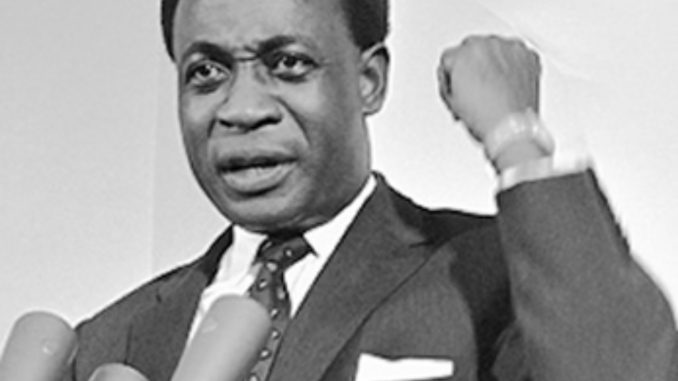
Today, July 9, 2026, marks 54 years since the body of Ghana’s first President, Dr. Kwame Nkrumah, was laid to rest in his hometown of Nkroful. Nkrumah died on April 27, 1972, at a clinic in Bucharest, Romania, where he had sought treatment while living in exile in Conakry, Guinea, following his overthrow in the 1966 coup. He had governed Ghana for nearly thirteen years, first as Prime Minister from 1952 and then as President from 1957, before being deposed while on a state visit to China and Vietnam. The journey of his remains to their initial resting place was a significant national event, steeped in both solemnity and political maneuvering. On Sunday, July 9, his coffin was flown to Nkroful, the Nzema town of his birth in what is now the Ellembelle District, where traditional rulers performed customary rites befitting his status as a divisional chief. After lying in state for three additional hours in his ancestral home, he was buried in a vault in his hometown, marking the culmination of a deeply emotional period for the nation.
Diplomatic Struggle Over Remains
His death set off months of tense diplomacy between Ghana’s military government, led by Colonel Ignatius Kutu Acheampong, and Guinea’s President Ahmed Sékou Touré. Touré had granted Nkrumah asylum and made him honorary co-president after his overthrow, a move that noted the deep ideological ties between the two leaders. The Guinean government initially insisted on burying Nkrumah in Conakry, but eventually relented to Ghana's demands for his return. On July 7, 1972, Nkrumah’s embalmed body was finally flown into Ghana aboard a specially arranged Guinean Air Force aircraft. Following its arrival, all flags across the country were ordered to fly at half-mast as a sign of national mourning, reflecting the profound impact of his passing. The next day, he lay in state at the State House in Accra for approximately ten hours, drawing thousands of mourners who came to pay their last respects to the revered leader. His widow, Madam Fathia Nkrumah, accompanied the coffin throughout this period, a poignant symbol of the personal loss intertwined with the national one. The extensive public viewing in the capital showed the widespread grief and respect for Nkrumah across Ghana.
From Nkroful to Accra Mausoleum
In 1992, under the government of Flight Lieutenant Jerry John Rawlings, Dr. Kwame Nkrumah’s remains were exhumed for a second time, a decision that sparked public debate but was ultimately seen as a move to solidify his national legacy. They were subsequently reinterred at the newly constructed Kwame Nkrumah Mausoleum in Accra. This mausoleum was built on the exact site of the old Polo Grounds, where Nkrumah had famously declared Ghana’s independence in 1957, a location charged with historical significance. The move solidified his place in Ghana's national memory, providing a permanent tribute in the capital city that was accessible to all Ghanaians and international visitors. The mausoleum serves as a memorial and a place of pilgrimage for many, offering a tangible connection to Ghana's independence struggle and its first president.
Enduring Legacy and Future Plans
In January 2026, Ghana’s government, led by President John Dramani Mahama, initiated negotiations with the Touré family. These discussions aimed to acquire Dr. Kwame Nkrumah’s former residence in Conakry, Guinea, a property that holds significant historical value as his home during his exile. The government's plans involve restoring the property to operate it as a Pan-African heritage and tourism site, transforming it from a private dwelling into a public landmark. This initiative began half a century after Ghana and Guinea initially engaged in diplomatic disputes over Nkrumah's remains following his death, noting the long-standing connection between his legacy and the two nations. The proposed restoration seeks to commemorate Nkrumah's time in exile and his broader contributions to Pan-Africanism, establishing a permanent historical landmark in Conakry that tells a key part of his story. The project reflects a continued commitment to preserving Nkrumah's international legacy, transforming a private residence into a public site of historical significance and promoting his ideals of African unity and liberation for future generations.