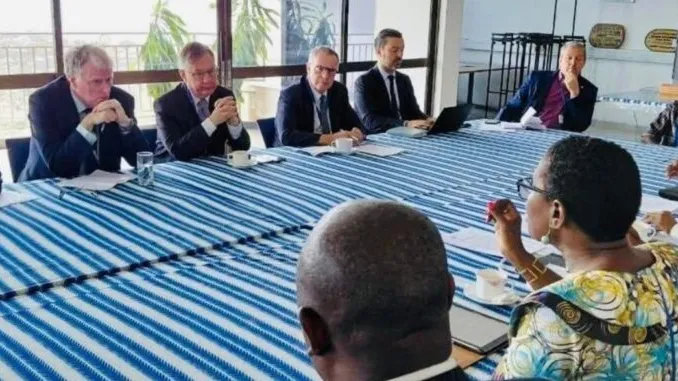
The European Union in Sierra Leone held a meeting with the leadership of the main opposition All People’s Congress party (APC) on Monday, as the APC announced the end of its boycott of parliament and local councils. The party had declared its boycott yesterday, signaling a significant development in the country's political landscape. The EU's engagement with the APC leadership comes amidst ongoing discussions about election integrity in Sierra Leone. This high-level engagement shows the international community's interest in the political developments in Sierra Leone and the resolution of the parliamentary boycott by the main opposition party.
EU Delegation Meets Opposition
The meeting between the European Union delegation and the All People's Congress party leadership involved several key diplomatic figures. Representing the EU were European Union Ambassador Jacek Jankowski, German Ambassador Dr. Pascal Richter, Irish Ambassador Patrick McManus, and Jaen Lamy, who serves as the French Chargé d’Affaires. The presence of multiple ambassadors indicated a unified European stance on encouraging dialogue and stability within the country's political framework. The discussions were part of broader efforts to foster a conducive political environment following the recent general and presidential elections. The European Union delegation emphasized the importance of all political actors engaging constructively to address national challenges.
Call for Unity and Integrity
Jacek Jankowski, the European Union Ambassador, affirmed that the full and timely implementation of the Agreement for National Unity and the Tripartite Committee Recommendations are vital for ensuring the integrity of elections in Sierra Leone. These recommendations are seen as key steps towards political stability and credible electoral processes in the country. Ambassador Jankowski also urged both the government and the All People’s Congress party (APC) to honor the eight-point resolution outlined in the Agreement for National Unity. He further pressed the APC to conclude its ongoing boycott of parliament and local councils, noting the necessity of all elected representatives participating in democratic institutions.
General and presidential elections in Sierra Leone are scheduled for 2028, making the current discussions and agreements significant for the nation's future political landscape. The EU's emphasis on these measures notes international expectations for transparency and fairness in the lead-up to the next electoral cycle. The call for adherence to these agreements is a cornerstone of the international community's support for Sierra Leone's democratic progress.
Opposition Responds to Dialogue
The European Union Ambassador's call for the APC to end its boycott aligns with broader international efforts to promote political stability and ensure the integrity of electoral processes in Sierra Leone. The APC party announced yesterday that its boycott of parliament and local councils has come to an end, a decision that follows intensive discussions with various stakeholders, including the European Union. This move is expected to allow the party to fully participate in legislative functions and local governance, contributing to the country's democratic institutions. The EU's engagement seeks to facilitate dialogue and consensus between the ruling party and the opposition, aiming for a peaceful resolution to the political impasse and fostering an inclusive political environment.
Broader Context and Future
The engagement between the European Union and the All People's Congress party focused on the importance of all parties upholding the eight-point communique from the International Moral Guarantors. According to the Freetown Mayor and presidential aspirant of the APC, the discussions aimed "to facilitate the speedy, effective and inclusive implementation of the Agreement for National Unity and the Tripartite Committee recommendations." This emphasis notes the international community's push for a full resolution to Sierra Leone's political challenges. The adherence to these agreements is seen as critical for fostering long-term stability and ensuring the credibility of future electoral processes in the country. The EU's continued commitment to dialogue and support for democratic principles in Sierra Leone shows its role as an important partner in the nation's political development.